Basic Info
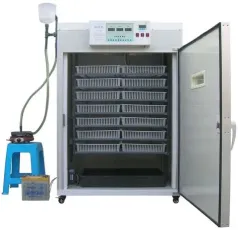
A specialized machine that simulates a broody hen's environment with automatic control of temperature,humidity,egg turning,and ventilation for the large-scale incubation of hatching eggs(chicken,duck,turkey,etc.).It is the starting point of the poultry production chain.
Product Description
Product Features:
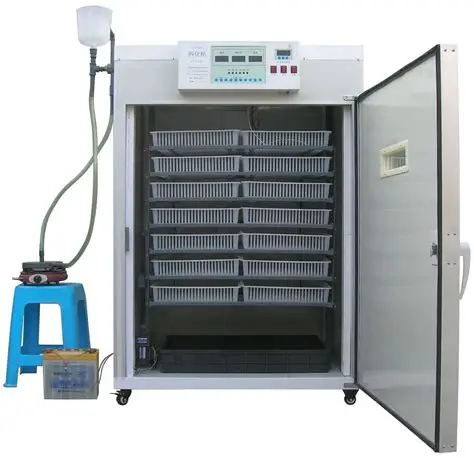
The core of a modern incubator is creating a highly stable,uniform,and precisely programmable micro-environment for embryo development.Advanced microprocessor control systems,using high-precision sensors and PID algorithms,minimize environmental fluctuations.Uniform air flow design(e.g.,tunnel airflow)ensures consistent temperature and humidity for every egg.Automatic turning mimics natural behavior,preventing embryo adhesion.Integrated alarm systems(for temperature,humidity,fan failure,power loss)can notify managers via SMS or network.Robust insulation and efficient heating/cooling systems ensure energy-efficient operation.Some high-end models feature CO₂monitoring and control.
Product Specifications:
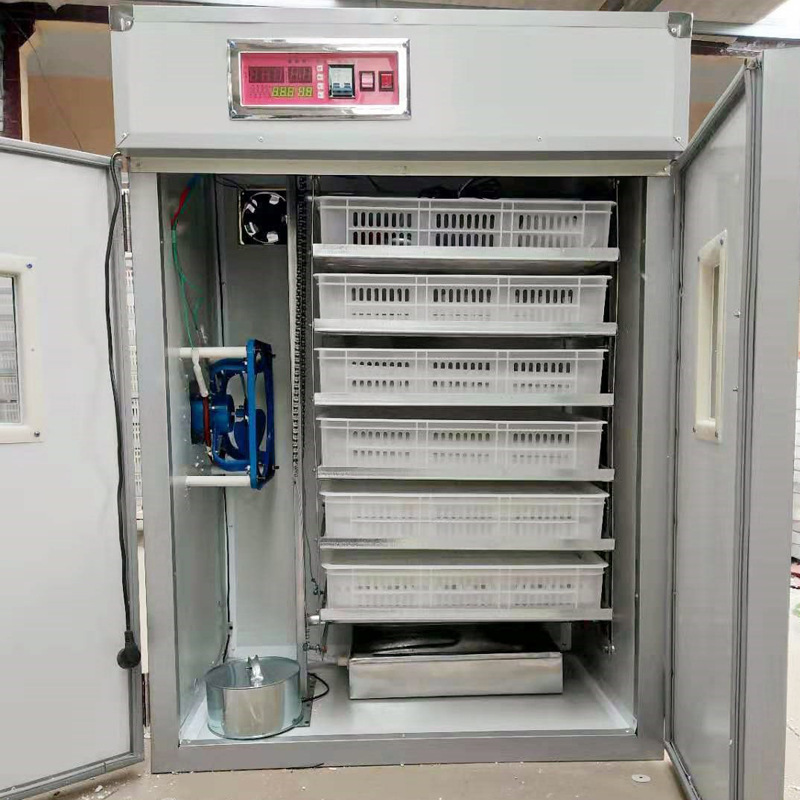
A mid-sized single-stage incubator holding 25,200 chicken eggs is roughly 4.5m L x 2.2m W x 2m H.Heating is provided by multiple electric elements;cooling uses chilled water coils or refrigeration compressors.Humidification is via ultrasonic humidifiers or water evaporation pans.A motor-driven gear or linkage system tilts the egg trays.The control system logs all operational parameters and events and can connect to a central monitoring room.The unit requires stable water,power,and drain connections.
Product Applications:
Used by primary breeder farms and large-scale commercial hatcheries.Selected and sanitized hatching eggs are loaded onto trays and rolled into the incubator.The entire incubation period(≈21 days for chickens)is managed automatically:maintaining higher temperature/humidity with frequent turning in the early"setter"phase,then ceasing turning and increasing humidity/ventilation in the later"hatcher"phase to facilitate hatching.Stable conditions are fundamental for achieving high hatchability and chick quality.Modern hatcheries often use separate setters and hatchers,integrated with automation for candling,transfer,sexing,vaccination,and chick processing into an efficient production line.
Frequently Asked Questions (FAQ)
Q:What key parameters should be considered when purchasing an incubator?
A:Focus on temperature control accuracy (±0.1°C), humidity fluctuation (±3% RH), and turning angle (±45°). High-quality incubators should feature backup power and multi-point temperature/humidity monitoring.
Q:How precise should temperature and humidity control be?
A:High-quality incubators should achieve: temperature fluctuation ≤ ±0.1°C, humidity fluctuation ≤ ±2% RH. High-precision sensors and PID microprocessor control systems are key.
Q:Why is automatic egg turning important?
A:Prevents embryos from sticking to the shell and promotes uniform development. Eggs should be turned automatically every 1-2 hours at an optimal angle of ±45°. Turning stops after transfer (around day 18-19).
Q:How to effectively clean and disinfect?
A:After each hatch, thoroughly remove shells and down, pressure wash the interior, then fumigate with formaldehyde or spray with food-grade disinfectant, followed by complete drying.
Q:What risks does the alarm system primarily prevent?
A:Core alarms include: over/under temperature, high/low humidity, fan failure, turning failure, and power loss. Audible/visual alarms and SMS notifications are the lifeline against batch losses.
Q:How to improve hatchability uniformity?
A:Ensure consistent egg quality and storage conditions. Airflow within the incubator should be uniform with no dead spots. Regularly check temperature differences at multiple points inside the machine; the variation should be less than 0.3°C.










 Post RFQ


 Chat
Chat


 ALL CATEGORIES