Basic Info
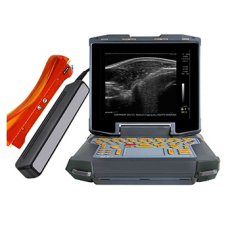
A portable ultrasound device used for in vivo measurement of backfat thickness and loin eye muscle area in pigs,cattle,etc.It is a key tool for genetic selection,breeding value estimation,and pre-slaughter carcass quality prediction.
Product Description
Product Features:
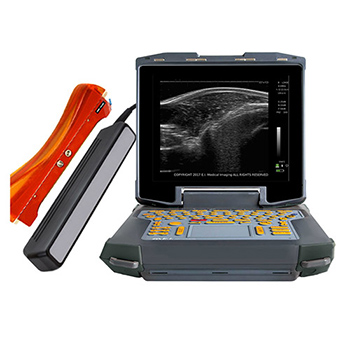
This instrument uses pulse-echo ultrasound technology.The probe emits high-frequency sound waves that penetrate tissue;echoes from different tissue interfaces(skin-fat,fat-muscle,muscle-bone)are received and processed to form a real-time cross-sectional image.Dedicated software allows precise on-image caliper placement for automated calculation of backfat and loin area.Its core value is the non-invasive,in vivo,real-time capture of key phenotypic data related to lean yield and carcass quality.Portability allows on-farm use.Durable probes withstand farm conditions,and measurements are accurate and repeatable,providing objective data for scientific breeding decisions.
Product Specifications:
A typical system includes a handheld main unit,one or more application-specific probes(e.g.,for the porcine P7 site),coupling gel,charger,and cables.Probe frequency determines imaging depth and resolution;a 5 MHz probe is common for pigs.The unit features image freeze,measurement calipers,and data storage for thousands of records.Measurement precision is at the millimeter level.Accompanying PC software manages data and,combined with pedigree information,can calculate Estimated Breeding Values(EBVs)to support selection in nucleus herds.
Product Applications:
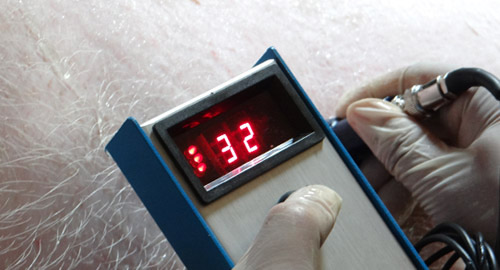
Primarily used in performance testing of nucleus herds in pig and cattle breeding operations.A trained technician restrains the animal,shaves and applies gel to a specific site(e.g.,the P7 site in pigs),and scans with the probe.The resulting backfat and loin area data are key indicators for calculating lean percentage and feed efficiency.This data is fed into national or company genetic evaluation systems to identify and select breeding stock with superior genetics for leaner,more muscular offspring,continuously improving commercial carcass quality and profitability.Also used for pre-slaughter quality prediction and grading.
Frequently Asked Questions (FAQ)
Q:Is the backfat thickness and loin eye area ultrasound scanner accurate?
A:Highly accurate. It uses high-frequency probes to clearly display subcutaneous backfat and loin eye contours, with a measurement error of less than ±0.5mm. Regular calibration and the use of coupling gel on the animal's skin are required.
Q:How is measurement accuracy ensured?
A:Accuracy relies on high-frequency probes (3.5-5MHz), standard coupling gel, and professional operation. Regularly calibrate the instrument with a standard phantom and measure at the same standard anatomical site (e.g., last rib on pigs).
Q:How valuable is in vivo data for breeding?
A:Extremely valuable. In vivo backfat and loin eye area are core traits for calculating lean meat percentage and evaluating feed conversion efficiency. They can be directly used in genetic evaluation, accelerating the selection of high-value breeding stock.
Q:How is data managed and analyzed?
A:Modern scanners have built-in software to automatically record individual ID, images, and measurements, generate reports, and export to computer breeding software, enabling data digitization for population genetic analysis.
Q:Do operators need special training?
A:Yes. Training focuses on animal restraint, locating standard measurement sites, proper probe placement technique, and image interpretation. Technicians can master the standardized procedure in a short time with training.
Q:Can it be used for animals other than pigs?
A:Yes. By using probes of different frequencies and shapes, it is widely used for measuring backfat thickness, intramuscular fat (marbling) in cattle and sheep, and even live follicle counting in sheep.










 Post RFQ


 Chat
Chat


 ALL CATEGORIES