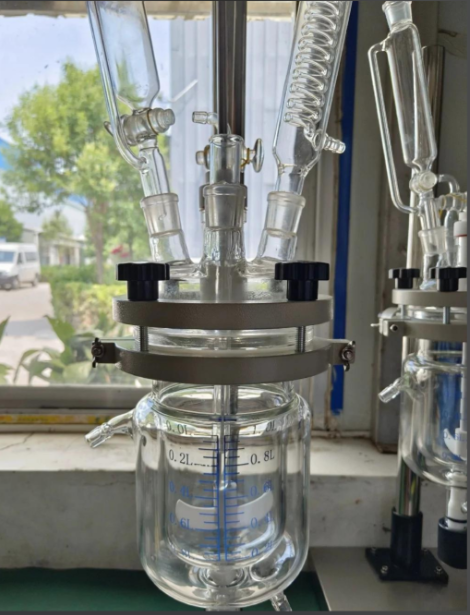
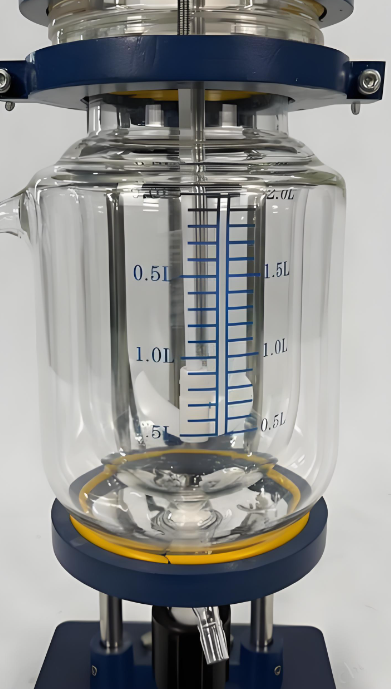





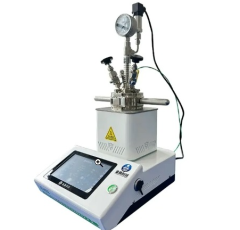
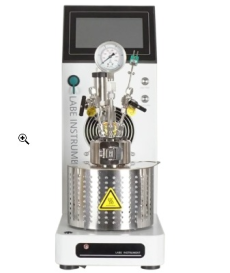
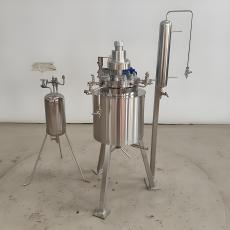
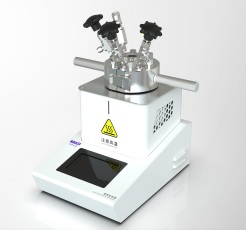

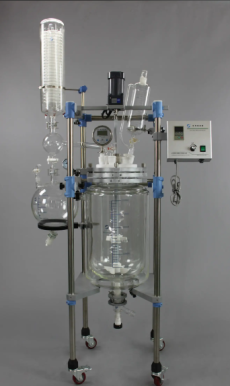
Its core advantage lies in the miniaturized design suitable for desktop use. The high borosilicate 3.3 glass resists thermal shock. The digital touch screen enables precise temperature control and speed adjustment, with an error controlled within ±1℃. The mechanical seal avoids material leakage, suitable for experiments with volatile reagents. The built-in overheat protection device improves experimental safety. Different from traditional large-scale reactors, this compact model does not require a dedicated lab bench and can be flexibly placed in a fume hood, making it ideal for undergraduate experimental teaching and early-stage R&D exploration in colleges and universities.
The overall dimensions are 300mm×250mm×400mm, with a total weight of 12kg. The inner diameter of the reactor cavity is 120mm, and the height is 180mm. The jacket water flow rate is 0.5L/min, and the temperature control response time is ≤30s. The stirring paddle is made of PTFE material, suitable for most acidic and alkaline reagents. The power interface complies with CE certification standards, adapting to global mainstream voltages. The maximum stirring torque is 3N·m, meeting the needs of trace reaction stirring.
It is suitable for undergraduate basic synthesis experiments in university chemistry laboratories, trace ratio testing in new material R&D, and small-dose pharmaceutical intermediate preparation in the biomedical field. It can be used in conventional chemical reactions such as esterification, hydrolysis, and polymerization, especially for visual experimental scenarios that require real-time observation of the reaction state, helping researchers obtain accurate experimental data efficiently.







 Post RFQ


 Chat
Chat


 ALL CATEGORIES