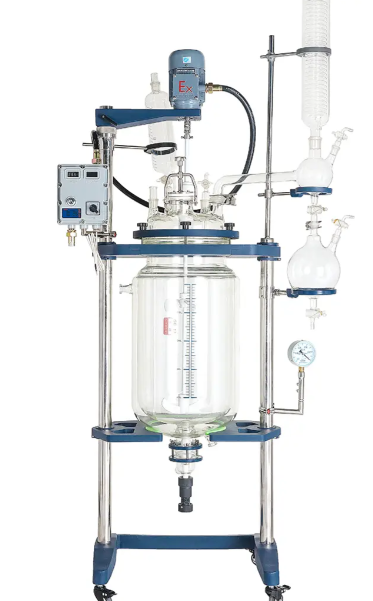
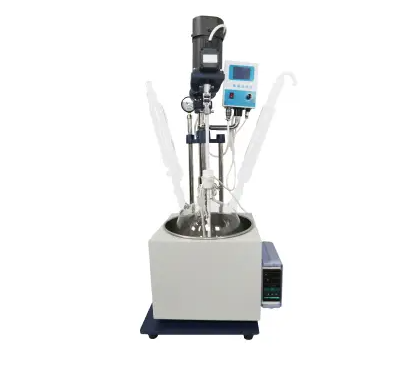





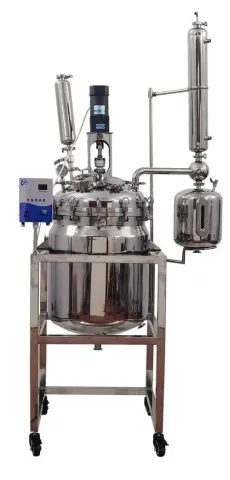
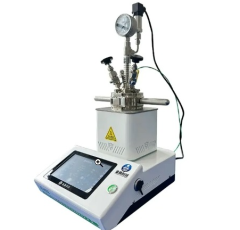
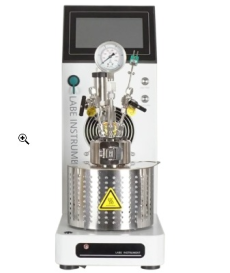
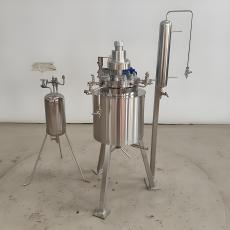
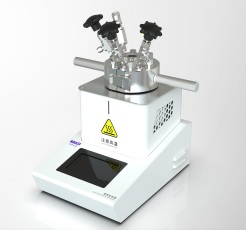

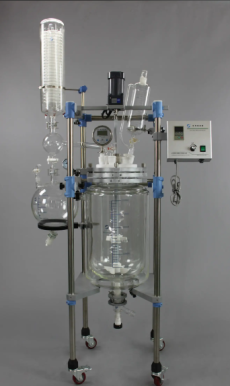
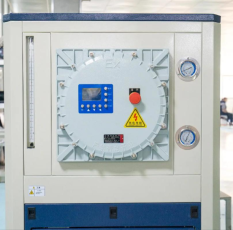
This equipment passes CE explosion-proof certification, adapting to chemical reactions containing volatile flammable and explosive solvents. The double mechanical seal structure further improves the sealing stability in a negative pressure environment. Compared with the traditional double-layer jacket, the three-layer jacket design increases the heat exchange efficiency by 40%, and can quickly realize temperature switching from -80℃ to 250℃, meeting the extreme reaction needs of cryogenic polymerization and high-temperature esterification. The PLC touch screen control system can realize fully automatic adjustment of temperature, rotation speed and vacuum degree, and supports data storage and export, which is convenient for researchers to回溯 experimental data. The 8mm thick high borosilicate glass material improves the impact resistance, avoiding the risk of glass fracture caused by sudden temperature changes, and it is also equipped with multiple safety protection devices such as over-temperature, overload and over-pressure to fully protect the safety of operators and equipment.
The overall size is 1200mm×850mm×1600mm, the net weight of the main unit is 185kg, the inner diameter of the glass container is 450mm, and the total height is 1200mm. The stirring paddle is made of Hastelloy alloy to adapt to strongly corrosive materials, and it is equipped with standard 29/32 ground mouth interfaces, which can be matched with external nitrogen protection devices. The power input is AC380V 50Hz, and it is equipped with an explosion-proof stirring motor and a special fixed bracket. The operating noise of the equipment is less than 65dB, and it supports remote control interface expansion.
It is mainly applicable to the pilot-scale synthesis of raw material medicines in the pharmaceutical industry, the production of flammable and explosive intermediates in the fine chemical field, and the polymerization reaction R&D of polymer materials. It can complete large-scale pilot-scale experiments that require strict explosion-proof and wide temperature control, with a single reaction material volume of 15-20 liters, replacing the amplification bottleneck of small laboratory equipment, and helping the R&D team quickly complete the transition verification from laboratory to industrial production.







 Post RFQ


 Chat
Chat


 ALL CATEGORIES