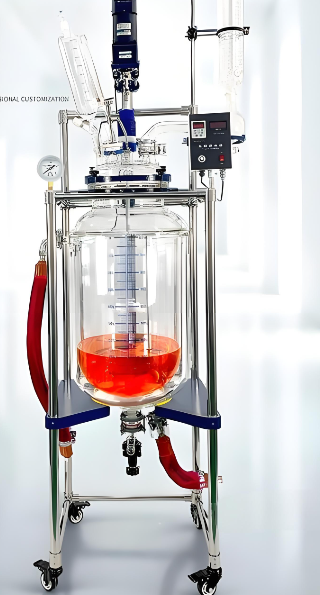
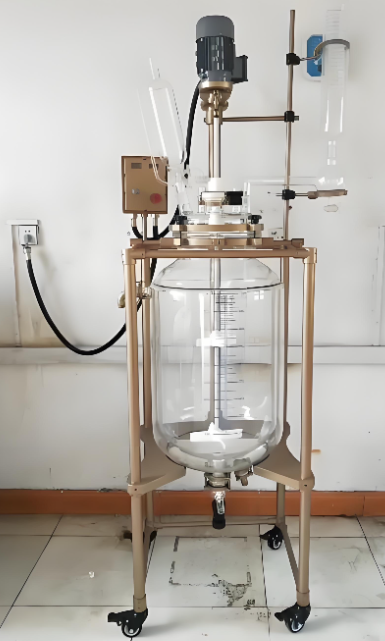





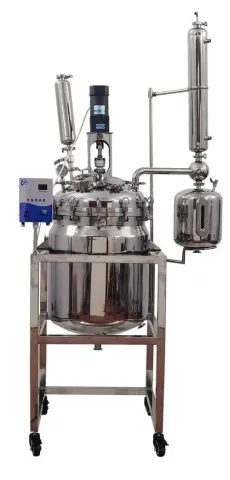
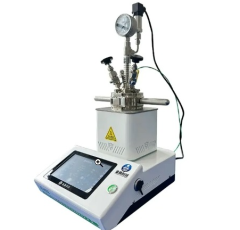
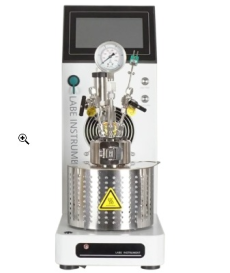
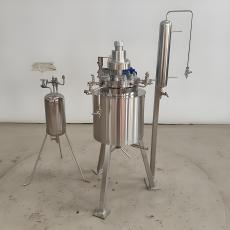
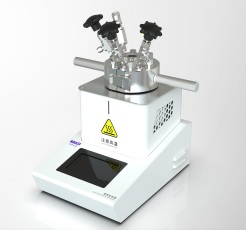

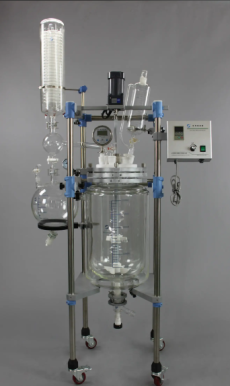
This reactor uses high borosilicate 3.3 glass material, which has excellent acid and alkali corrosion resistance and high temperature impact resistance, adapting to most conventional chemical synthesis scenarios. The double-layer jacket design enables efficient heat exchange, and it can accurately control the reaction temperature range from -20℃ to 200℃ with an external constant temperature tank. The PTFE mechanical seal ensures no leakage in a negative pressure environment, with a maximum vacuum of -0.098MPa, meeting the reaction needs of distillation, reflux and other sealed reactions. The digital speed control can realize stepless speed regulation from 0 to 2000 rpm, adapting to reaction systems with different viscosities. It is also equipped with an overload protection device to improve the safety of equipment operation. Compared with traditional glass containers, it greatly reduces the safety risks and material loss during the reaction process.
The overall size is 450mm×380mm×720mm, the net weight of the main unit is 28kg, the inner diameter of the glass container is 220mm, and the total height is 580mm. The stirring paddle is made of 304 stainless steel, and it is equipped with standard 24/40 ground mouth interfaces, which can be matched with auxiliary accessories such as condensers and feeding funnels. The power input is AC110/220V 50/60Hz, and it is equipped with a special stirring bracket and fixing fixture. The operating noise of the equipment is less than 55dB.
It is mainly applicable to basic experimental teaching of chemistry and chemical engineering majors in colleges and universities, raw material extraction and synthesis R&D of small biomedical enterprises, and formula optimization testing of fine chemical studios. It can complete a variety of normal or negative pressure chemical reactions such as esterification, polymerization and hydrolysis, especially suitable for small-scale R&D scenarios with single reaction material volume of 1-5 liters, replacing the simple combination of traditional glass flasks and improving the controllability and repeatability of reactions.







 Post RFQ


 Chat
Chat


 ALL CATEGORIES