Basic Info
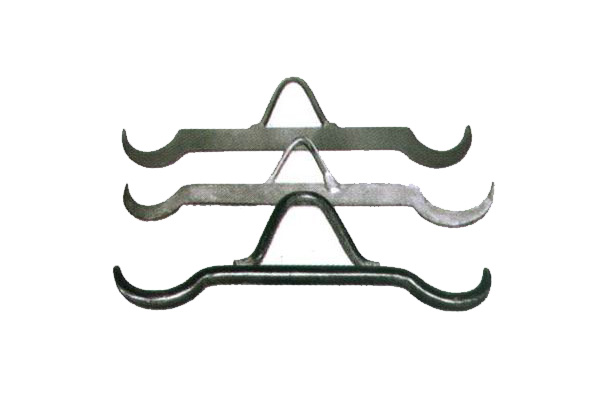
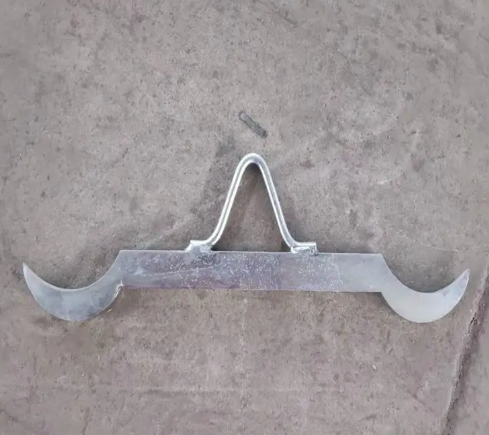
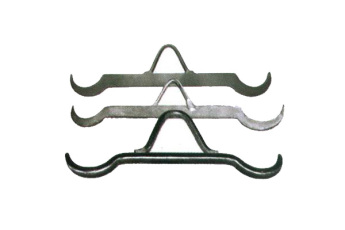
The carcass spreader, also known as a gambrel, is a simple yet crucial slaughter tool used to spread and secure the hind legs of livestock after bleeding. Inserted between the tendons of the hind legs, it maintains the carcass in a stable hanging posture during subsequent skinning, processing, and chilling, ensuring operational safety, smooth workflow, and promoting uniform carcass cooling.
Product Description
Product Features:
The core advantages of this product lie in its high strength, corrosion resistance, and ergonomic design. Manufactured from high-hardness martensitic stainless steel, it effectively resists deformation and fracture under high tension and frequent use. The adjustable width design accommodates livestock of varying sizes and breeds, and can be quickly secured via spring-lock pins or threaded mechanisms. The anti-slip teeth at the tips firmly grip the leg tendons, preventing the carcass from slipping or rotating during processing and ensuring operational safety. The entire product undergoes electropolishing, resulting in a smooth, pore-free surface that is easy to clean and disinfect thoroughly, complying with relevant hygiene standards for food-contact materials (such as FDA CFR 21 or EU Framework Regulation 1935/2004).
Product Specifications:
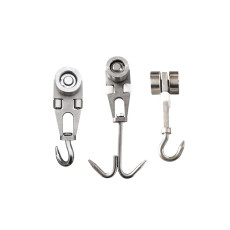
The standard gambrel length is approximately 1 meter for cattle and 0.6 meters for pigs. The main bar diameter is typically 20 mm (for cattle) and 16 mm (for pigs). The adjustment notches are clear and lock securely. The product design is validated through Finite Element Analysis to ensure reasonable stress distribution. All edges are rounded to prevent unnecessary damage to the carcass or cuts to the operator. This product is directly compatible with standard hooks or trolleys on slaughter line conveyors.
Product Application:
After the stunning and bleeding process, the operator uses a specialized tool to make an incision above the hoof on the hind legs of cattle or pigs, exposing the tendons. The two prongs of the gambrel are then inserted into the incisions on both sides, adjusted to the appropriate width, and locked. The upper hook of the gambrel is then attached to the main hook of the conveyor line via a hoist or manually, completing the transfer from the bleeding rail to the main processing rail. The spread and fixed carcass provides a stable posture, creating suitable working conditions for subsequent steps such as mechanical skinning (for cattle) or scalding (for pigs), evisceration, and viscera removal. Additionally, it helps maintain proper spacing of carcasses in the pre-cooling chamber, promoting air circulation for even cooling.
Frequently Asked Questions (FAQ)
Q:Why choose martensitic stainless steel over regular stainless steel?
A:Martensitic stainless steel (e.g., grade 420) can achieve higher strength and hardness through heat treatment, enabling it to withstand the immense tension and impact of slaughter line hanging. It is significantly more durable and resistant to bending than austenitic grades like 304.
Q:Is the width adjustment range of the gambrel fixed?
A:Not entirely. We offer various models covering size ranges for different species like cattle, pigs, and sheep (e.g., 500-800mm for cattle). Custom sizes are available upon request.
Q:Will the anti-slip teeth damage the animal's leg tendons?
A:No. The tooth design is optimized to provide sufficient grip to prevent slippage while featuring rounded tips that avoid cutting or seriously damaging the tendons, aligning with animal welfare and meat quality preservation.
Q:Can it withstand high-temperature washing and chemical disinfection?
A:Absolutely. The electropolished surface and high-quality stainless steel material can tolerate hot water washdown (up to 85°C) and common chlorine-based or peracetic acid disinfectants, complying with hygiene standards for food-contact materials.
Q:How does it interface with different slaughter line hooks?
A:The gambrel's top features a standard hook or link design for direct hanging on most conveyor line hooks. We also provide adapter fittings for special interface requirements.
Q:How many gambrels are needed per animal?
A:Typically, one gambrel per animal is used, inserted into the hind legs to support the entire carcass. Special processes (e.g., hanging sheep with skin) might use dedicated double-hook leg gambrels.










 Post RFQ


 Chat
Chat




 ALL CATEGORIES