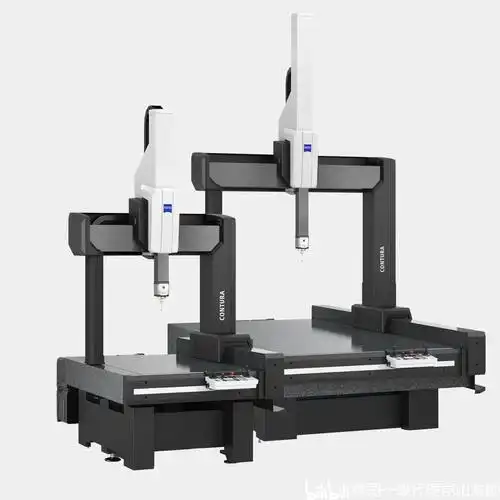
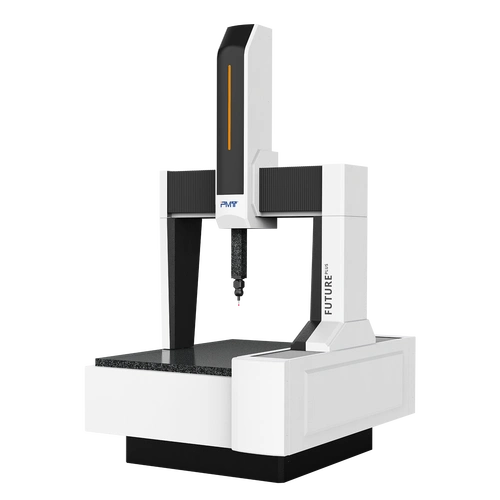






This bridge CMM features a fully automated CNC servo drive system that eliminates manual intervention, greatly improving detection efficiency and measurement consistency. It is equipped with a temperature adaptive compensation module, which can automatically correct measurement errors caused by environmental temperature changes within 10-30℃, ensuring accurate measurement results in different workshop environments. The contact ruby probe has high wear resistance and ultra-high repeat positioning accuracy, which can meet the detection needs of ultra-precision parts. In addition, it supports offline programming and remote data sharing, which can effectively reduce production preparation time and realize interconnection with the workshop MES system, solving the pain points of low informatization level of traditional detection equipment.
The specific technical specifications are as follows: The effective measurement range is X-axis 800mm, Y-axis 600mm, Z-axis 500mm; the overall measurement accuracy is ±0.8μm (compliant with ISO 10360-2 international standard); the drive system adopts high-torque servo motor and precision ball screw transmission, with stable operation and low noise; the matching measurement software is PC-DMIS Professional 2024, which supports multiple types of probe matching and complex curved surface detection; the workbench is made of natural Hanbian granite, which has low thermal expansion coefficient and good stability; the maximum load capacity of the workbench is 1500kg; the maximum scanning speed can reach 200 measuring points per second; the data interfaces include USB 3.0 and Gigabit Ethernet to support fast data transmission; the whole machine size is 1800mm (length) × 1500mm (width) × 2000mm (height); the power supply is compatible with 220V 50Hz/60Hz, and the protection grade is IP54.
This product is widely used in automotive manufacturing, aerospace, mold processing, precision hardware and other industries. Typical application scenarios include dimensional detection of automotive chassis parts, engine cylinder heads, turbine blades, precision mold profiles and 3C electronic component shells. It can also be used for reverse engineering of parts, providing accurate three-dimensional data for product redesign and mold repair. In the automotive industry, it can help enterprises quickly detect the dimensional accuracy of batch parts, reduce the defect rate, and improve production efficiency. In the aerospace field, it can meet the high-precision detection requirements of complex precision parts such as aircraft engine blades.







 Post RFQ


 Chat
Chat


 ALL CATEGORIES