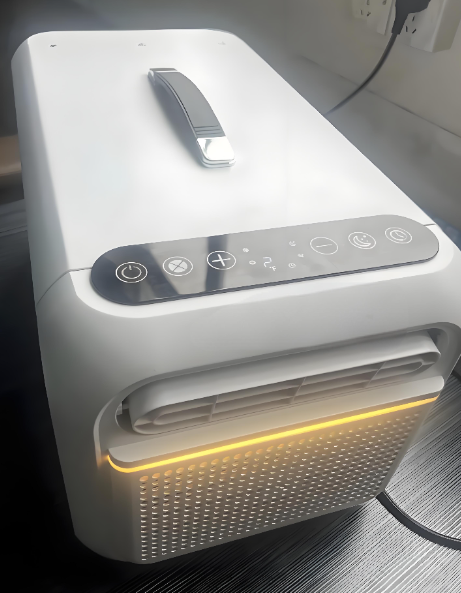
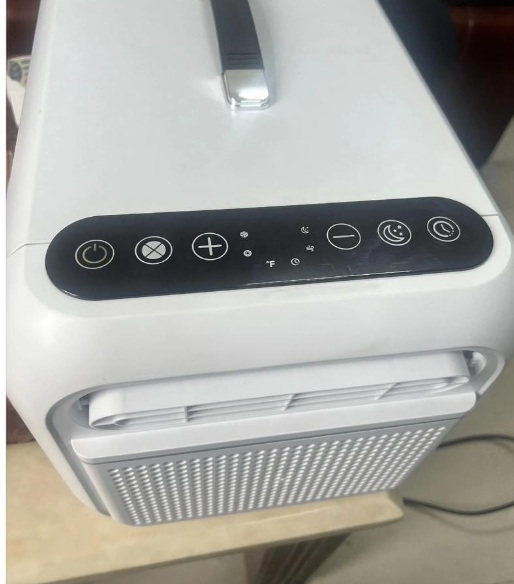





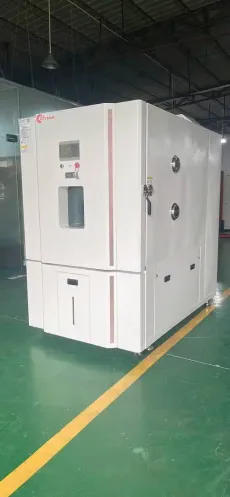

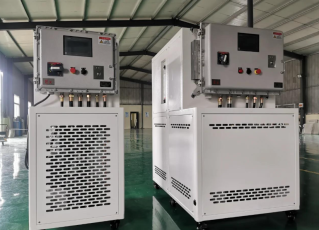
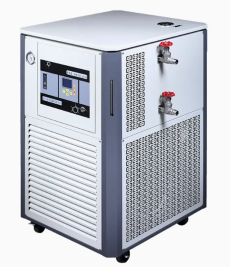
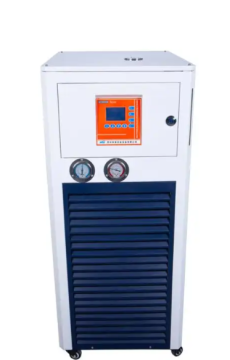
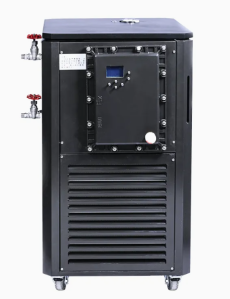
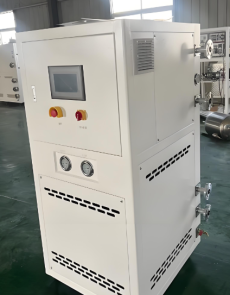
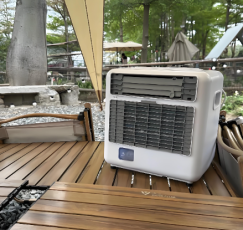
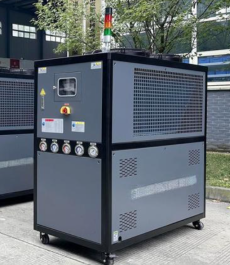
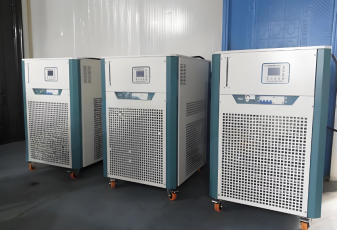
Its core advantage lies in portability and compact design. It adopts aluminum alloy shell, with a weight of only 35kg, and is equipped with universal wheels that can be easily moved to any scene. It supports AC220V civilian power supply, no special industrial power supply is required, adapting to field temporary power supply scenarios. The temperature control range covers -10℃ to 100℃, meeting most of the temperature control needs of field detection. The ±0.3℃ temperature control accuracy ensures the accuracy of detection data. It is equipped with a silent compressor, and the operating noise is lower than 55dB, which will not interfere with on-site detection work. It is equipped with a touch screen, which is easy to operate and does not require professional training to use. It supports emergency manual operation to prevent electronic system failures, improving the reliability of the equipment.
The overall size is 450*350*600 mm, net weight is 35 kg, and the power supply is AC 220V 50/60Hz. The temperature control range is -10℃ to 100℃, and the temperature control accuracy is ±0.3℃. The heating power is 1.5kW, the cooling power is 1.2kW, and the circulating flow rate is stable at 8L/min. Deionized water is used as the standard temperature control medium, and a small amount of ethanol solution can also be adapted. It is equipped with a 5-inch touch screen, supporting real-time temperature display and parameter adjustment. The equipment has a built-in lithium battery backup, which can maintain short-term temperature control after power failure, ensuring the continuity of on-site detection. It is equipped with quick connectors that can quickly connect all kinds of test equipment.
It is mainly used in field environmental monitoring, mobile laboratory detection, vehicle cold chain monitoring, on-site material performance test, temperature control of outdoor scientific research sampling and other scenarios. It can be matched with portable spectrometers, gas chromatographs and other field detection equipment as an auxiliary temperature control unit. It can also be used for constant temperature storage of equipment in outdoor events and emergency rescue, providing a stable temperature environment for precision instruments, solving the problem of no fixed temperature control equipment in the wild.







 Post RFQ


 Chat
Chat


 ALL CATEGORIES