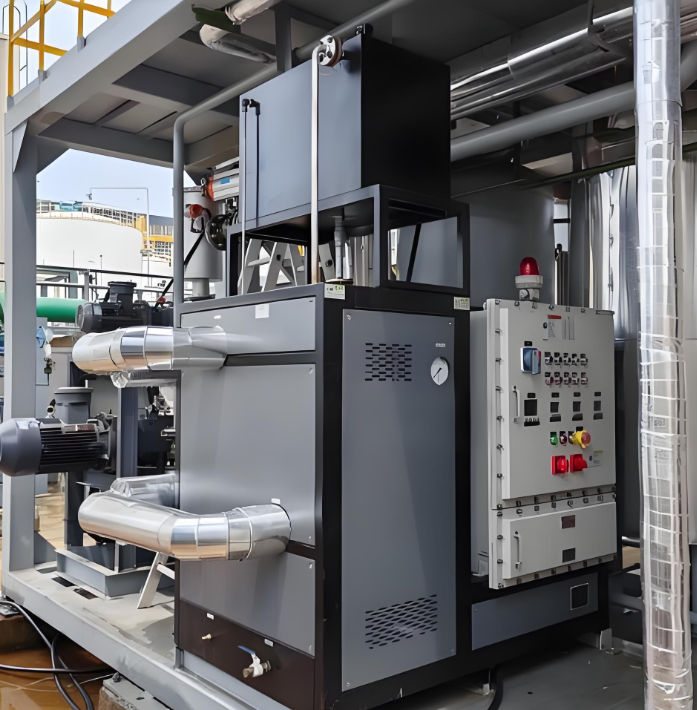
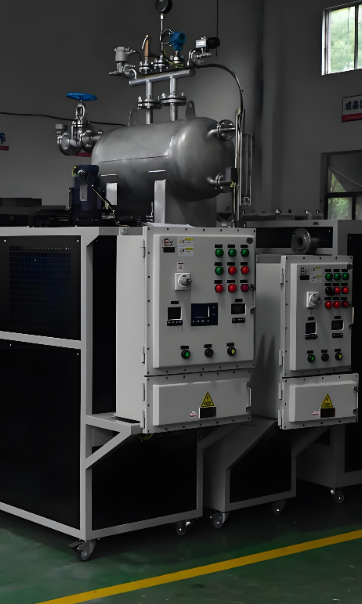





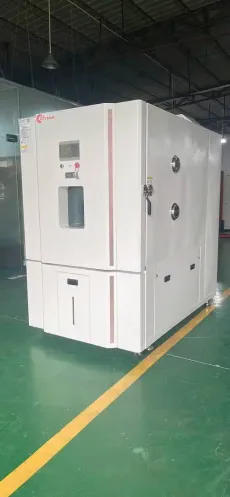

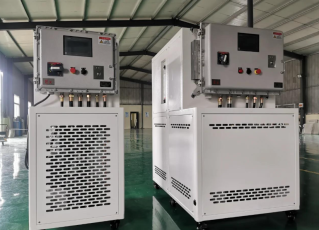
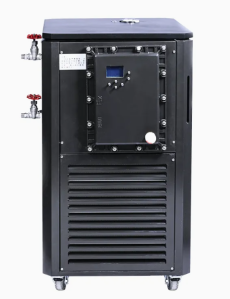
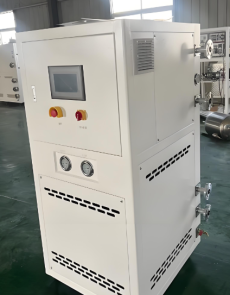
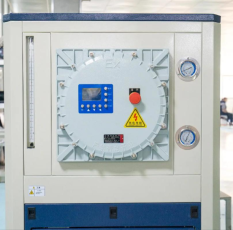
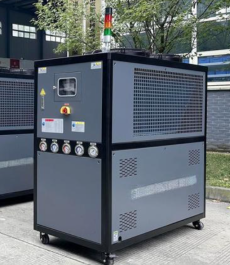
Its core advantage lies in explosion-proof safety and industrial-grade durability. It adopts Ex d IIB T4 explosion-proof rating that meets ATEX standards, adapting to dangerous environments such as gas stations and chemical workshops where flammable gases exist. It is equipped with an industrial-grade PLC automatic control system, supporting remote monitoring and abnormal alarm, reducing manual operation risks. The carbon steel anti-corrosion shell is resistant to acid and alkali corrosion in industrial environments, extending the service life of the equipment. The 5.5kW heating power and 4.5kW cooling power can quickly respond to temperature changes in industrial production, and the large flow rate of 30L/min ensures temperature transfer efficiency. It is equipped with multiple explosion-proof safety protection mechanisms including over-temperature, over-pressure, overload and leakage protection, eliminating potential safety hazards, which is different from the insufficient safety performance of ordinary civilian temperature control equipment.
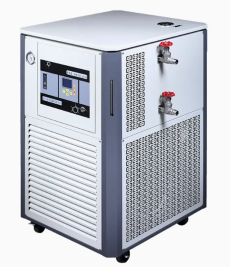
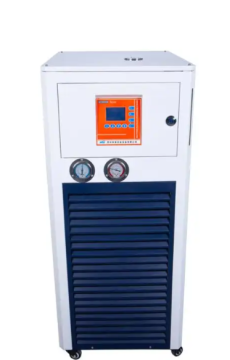
The overall size is 1000*750*1400 mm, net weight is 320 kg, and the power supply is AC 380V 50/60Hz. The temperature control range is -20℃ to 180℃, and the temperature control accuracy is ±0.5℃. The heating power is 5.5kW, the cooling power is 4.5kW, and the circulating flow rate is stable at 30L/min. Heat transfer oil is used as the standard temperature control medium, adapting to industrial high-temperature working conditions. It is equipped with a 10-inch industrial touch screen, supporting parameter presetting, data storage and remote networking monitoring. The operating noise of the equipment is lower than 70dB, meeting the noise standards of industrial plants. All electrical components are explosion-proof designed, meeting the use requirements of dangerous places.
It is mainly used in reaction kettle temperature control in chemical industry, rectification tower auxiliary temperature control in petroleum refining, raw material pharmaceutical synthesis temperature control in pharmaceutical industry, coating production mixing reaction temperature control and other scenarios. It can be matched with various reaction equipment in industrial production lines to achieve continuous and stable temperature control. It can also be used for temperature regulation in the processing and storage of flammable and explosive materials, ensuring the safety of the production process and the consistency of product quality.







 Post RFQ


 Chat
Chat


 ALL CATEGORIES