


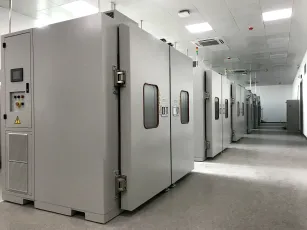
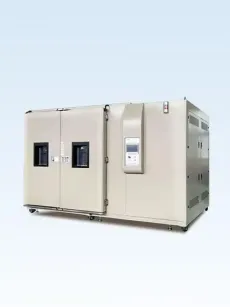
This test chamber adopts a double-cycle air duct design, ensuring that the temperature and humidity uniformity deviation in the chamber is no more than ±1℃, improving the consistency of test data by 30% compared with traditional single-air duct equipment. It is equipped with high-precision platinum resistance temperature and humidity sensors with fast response speed, and the temperature and humidity control accuracy reaches the level. It is equipped with multiple safety protection mechanisms, including over-temperature power-off, sensor failure alarm and door interlock protection, to avoid safety accidents during the test process. It supports remote monitoring and data export functions, and can be connected to the cloud via WIFI to view test data in real time and generate standardized test reports, greatly improving test efficiency. It uses food-grade stainless steel inner tank, which is corrosion-resistant and easy to clean, with a service life twice as long as that of ordinary cold-rolled steel inner tanks, and it also has a silent operation design with working noise lower than 60dB, adapting to the quiet environment requirements of the laboratory.
The external dimensions are 1200mm (W) × 1800mm (D) × 2000mm (H), and the internal dimensions are 800mm (W) × 1000mm (D) × 625mm (H). The total weight of the whole machine is 850kg. The refrigeration system adopts imported fully enclosed compressors, and the refrigerant is R404A. The heating system adopts nickel-chromium alloy electric heating wires, and the humidification system adopts stainless steel humidifiers. The control interface is a 7-inch color touch screen, supporting up to 100 sets of test cycle programming, and the data storage capacity can reach 10000 sets of test records. The power interface specification is three-phase five-wire system. The working environment temperature requirement is 15℃~35℃, and the relative humidity is ≤85%RH.
It is applicable to reliability testing of PCB boards and chips in the electronic manufacturing industry, weather resistance testing of vehicle lamps and interior materials in the automotive industry, environmental adaptability testing of small parts in the aerospace field, as well as teaching and research of material science and environmental science in colleges and research institutes. Typical application scenarios include consumer electronics manufacturers conducting high-temperature and high-humidity aging tests before mass production of new products to verify the stability of batteries and screens, and third-party quality inspection institutions providing environmental testing services related to ISO certification for enterprises.







 Post RFQ


 Chat
Chat


 ALL CATEGORIES