




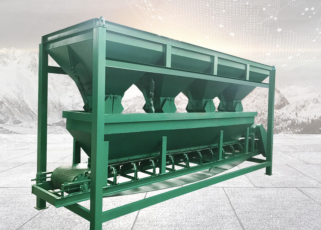
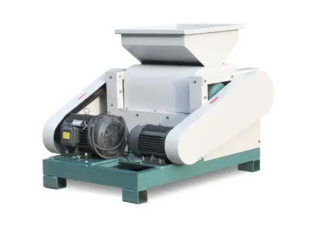
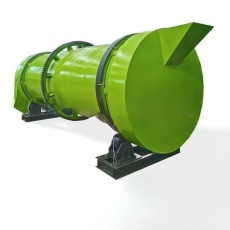
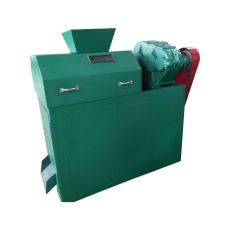
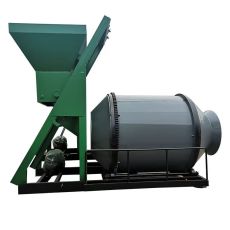
The equipment adopts a ribbon or paddle-type mixing structure with reasonably arranged mixing blades, which can form a strong convective mixing effect. The mixing uniformity is relatively high, meeting the requirement for uniform nutrient distribution in fertilizer production. It covers a wide range of effective volumes, suitable for small-batch experiments to large-scale production with strong flexibility. The mixing speed and mixing time can be adjusted according to material characteristics, adapting to the mixing needs of raw materials with different viscosity and humidity. The machine body adopts a sealed design to reduce dust leakage, complying with environmental protection requirements. The discharging method uses a pneumatic or manual butterfly valve, ensuring fast discharging speed and less residual material. With a robust overall structure, the parts in contact with materials are made of rust-proof materials, resulting in low maintenance frequency and suitability for long-term continuous operation scenarios.
The material can be 304 stainless steel or carbon steel, among which 304 stainless steel has relatively strong corrosion resistance, suitable for mixing raw materials containing corrosive components. The effective volume ranges from 100L to 5000L, and the motor power is 2.2-75kW. The power configuration matches the volume reasonably, leading to relatively low operating energy consumption. The mixing speed is 20-60r/min, and the mixing time is 3-10 minutes per batch, which can improve production efficiency while ensuring mixing effect. The feed particle size is required to be ≤10mm to avoid large particle raw materials affecting mixing uniformity. The sealing structure adopts packing seal or mechanical seal with good sealing performance, reducing material leakage and dust pollution. Some models support optional heating function, meeting the special process requirements of temperature-rising mixing. The equipment's protection class is not lower than IP44, and the insulation class is Class F, ensuring high operational safety.
In the chemical fertilizer industry, it is mainly used for mixing raw materials of compound fertilizer, organic-inorganic compound fertilizer, biological fertilizer and other products. It uniformly mixes various components such as nitrogen-phosphorus-potassium single fertilizers, organic fertilizer raw materials, trace elements, and binders, ensuring stable and balanced fertilizer efficiency of finished products. Meanwhile, the equipment is also suitable for scenarios such as feed formula mixing in the feed industry, powder raw material mixing in the chemical industry, and mortar and coating raw material mixing in the building materials industry. It has strong adaptability and can handle materials in various forms such as powder and granules, especially suitable for production scenarios with high requirements for mixing uniformity. Whether it is a small fertilizer processing plant or a large-scale chemical fertilizer production enterprise, the corresponding specification of equipment can be selected according to production capacity needs, providing support for large-scale production or customized formula production.







 Post RFQ


 Chat
Chat


 ALL CATEGORIES