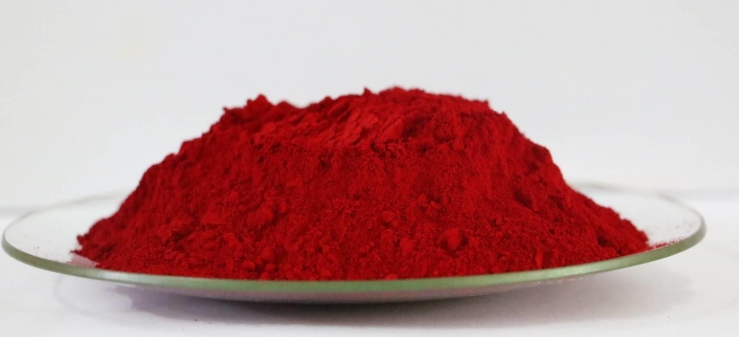
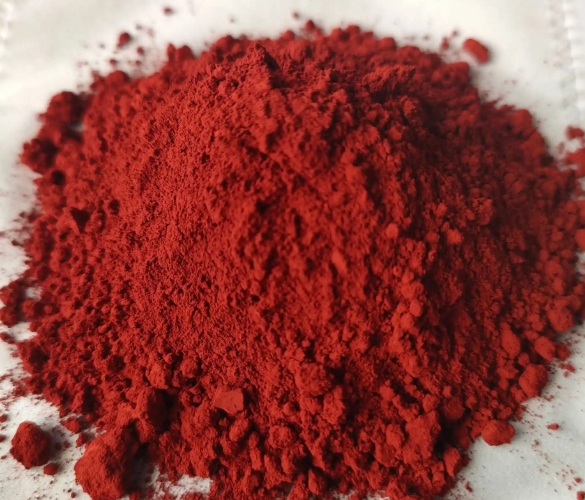





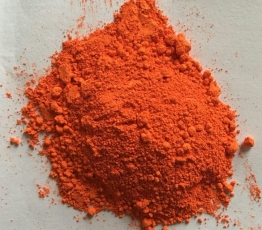
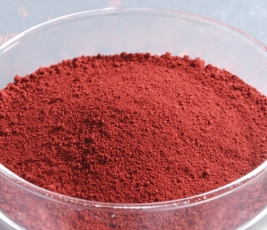
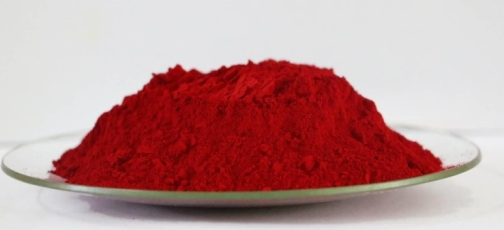
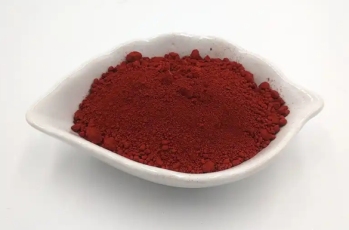
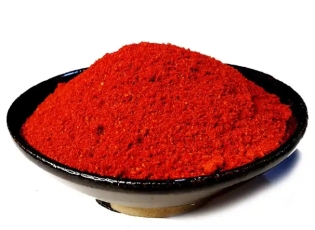
Produced by synthetic method, the product has a purity of up to 99.5%, avoiding the color difference caused by impurities in natural iron oxide red. It has been calcined at high temperature, with a heat resistance of up to 300℃, suitable for ceramic glazes and high-temperature plastic processing scenarios. The original dispersant coating process improves the dispersion stability in water-based systems, solving the industry pain point of easy sedimentation of traditional iron oxide pigments. It has passed FDA food contact certification, and can be used for food packaging coatings and kitchen utensils coloring. The light fastness reaches level 8, far exceeding industry standards, and can maintain the original red color tone after more than 5 years of outdoor exposure.
The main chemical component is ferric oxide (Fe₂O₃), with a content of ≥99.5%. The color tone can be divided into two specifications: blue-phase red and yellow-phase red, meeting different color matching needs. The light fastness complies with ASTM D4303 standards, with a grade of 8. The heat resistance temperature can reach 300℃, and it will not decompose and discolor during high-temperature processing. The oil absorption is 20-30 g/100g, suitable for coating systems with different viscosities. The average particle size is 0.3-1.0 μm, balancing coloring power and dispersibility. The moisture content is ≤0.5%, with no harmful volatile substances. The product is packaged in 20kg moisture-proof kraft paper bags, with a shelf life of up to 5 years, complying with GB/T 1863-2008 standards.
It is mainly used in outdoor architectural exterior wall coatings, floor coatings, ceramic glazes, high-temperature plastics, rubber products, food packaging coatings and other fields. In outdoor architectural coating, it can be used to produce red exterior wall paint, resisting ultraviolet radiation and rain erosion, and maintaining a bright red appearance for a long time. In the ceramic industry, it is used to prepare high-temperature glazes, providing stable red decoration for tableware and architectural ceramics. In the food packaging field, it can be used for printing inks and coatings, meeting food safety standards and will not contaminate food. It can also be used in anti-rust coatings, with both anti-rust and decorative functions.







 Post RFQ


 Chat
Chat


 ALL CATEGORIES