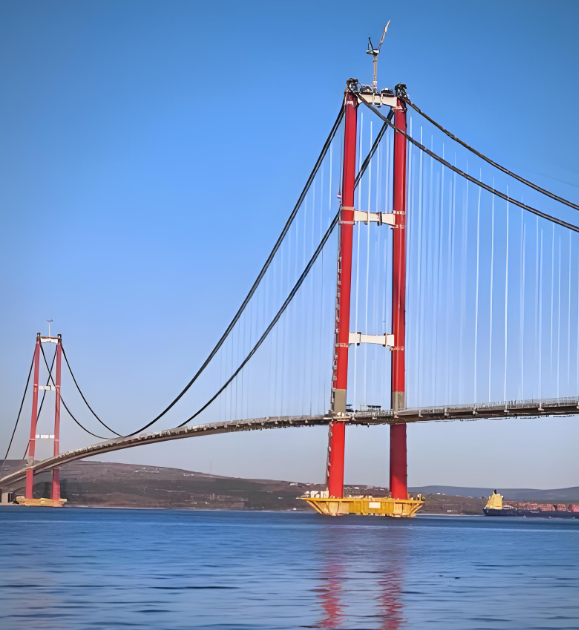
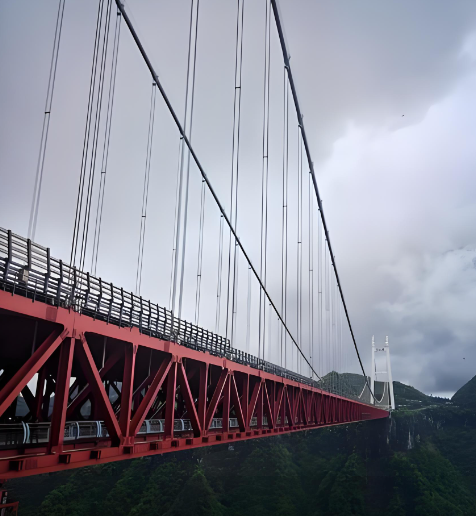







This heavy-duty suspension bridge offers industry-leading performance through its innovative material and design features. The use of CFRP cables is a key technical breakthrough, providing 5 times the strength-to-weight ratio of traditional steel cables, which allows for longer spans without increasing tower size or foundation requirements. The reinforced concrete caisson foundations are engineered to withstand extreme seismic activity, with deep anchoring into bedrock to prevent structural displacement during earthquakes. A integrated structural health monitoring system uses sensors to track cable tension, tower deformation, and deck vibration, providing real-time data to maintenance teams and enabling predictive repairs before issues escalate. To address freight logistics pain points, the bridge’s 24-meter-wide deck accommodates 6 lanes of traffic, including dedicated heavy truck lanes with reinforced deck panels to resist wear from repeated heavy loads. Additionally, the bridge’s aerodynamic tower shapes and tuned mass dampers reduce wind-induced vibration, ensuring stable performance even in hurricane-force winds up to 180 km/h.
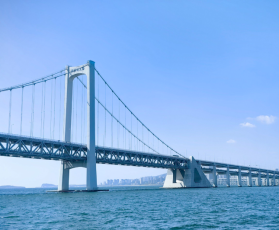
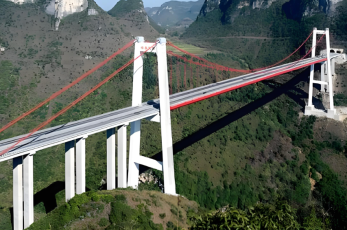
The main span of this highway suspension bridge measures 650 meters, with a total structure length of 1200 meters including 275-meter approach spans on each end. The deck width of 24 meters supports 6 traffic lanes (3 in each direction), each with a maximum vehicle load capacity of 100 kN, allowing for safe passage of 40-ton heavy-duty trucks. The twin concrete towers stand 180 meters tall, with a base diameter of 12 meters and a tapering design to reduce wind resistance. The main suspension cables are made of 1.2-meter-diameter CFRP bundles, while the secondary hangers are 80mm steel cables spaced 15 meters apart. The reinforced concrete caisson foundations are 30 meters deep, anchored into bedrock for maximum stability. The bridge’s seismic resistance rating of magnitude 8.5 complies with international bridge design standards, and its wind resistance system can withstand gusts up to 180 km/h. The integrated structural health monitoring system includes 200+ sensors, providing real-time data to a central control room for continuous performance tracking.
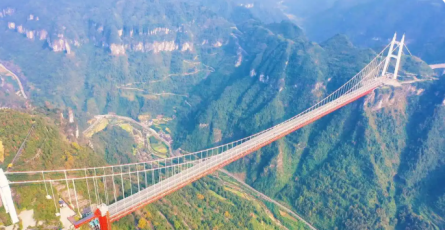
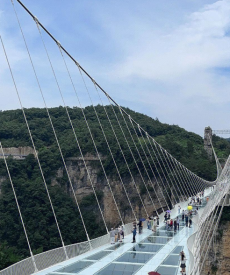
This long-span suspension bridge is designed for critical intercity and regional highway infrastructure projects. It is ideal for crossing wide rivers or estuaries, where it can replace ferry services and reduce travel time for freight and passenger traffic by up to 70%. In mountainous regions, it can connect isolated highway networks over deep valleys, eliminating dangerous winding roads and improving overall transportation safety. Coastal areas can benefit from its corrosion-resistant materials and durable design, which withstand salt air and harsh marine environments. The bridge is also suitable for freight logistics corridors, where its high load capacity and wide lanes support efficient movement of commercial vehicles, reducing supply chain delays. Additionally, it can be integrated into high-speed highway networks, providing a seamless connection between major cities and supporting economic growth by enhancing regional accessibility. Government transportation agencies can use this bridge to upgrade aging infrastructure, while private-public partnerships can leverage it to fund and develop critical transportation links.















 Post RFQ


 Chat
Chat


 ALL CATEGORIES