Basic Info
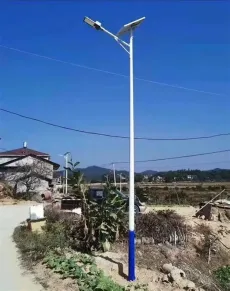
The split-type solar street light features a separate design for the photovoltaic panel,battery,controller,and luminaire head,offering greater system configuration flexibility and maintenance convenience.It is particularly suitable for remote roads,rural highways,and park pathways where grid connection is difficult.
Product Description
Product Features:
Utilizes high-efficiency monocrystalline silicon PV panels with energy conversion rates exceeding 21%;equipped with an intelligent charge/discharge controller featuring dusk-to-dawn,time control,and overcharge/over-discharge protection functions.The separated luminaire head and battery system offer superior heat dissipation,effectively extending LED lifespan.The modular design facilitates future maintenance and component upgrades.

Product Specifications:
Common system configurations include a 100W PV panel,100Ah lithium battery,and 60W LED luminaire head.Autonomy can last 3-5 cloudy/rainy days.Pole height is typically 6-8 meters,installed on a concrete foundation.Operating temperature range is-30℃to 50℃.

Product Applications:
Primarily used for highways,village roads,courtyards,parking lots,tourist trailways,and campsites in areas without grid power supply.Its off-grid,independent power supply characteristic significantly saves on cable laying and long-term electricity costs,making it an ideal choice for green lighting.
Frequently Asked Questions (FAQ)
Q:How long can this light operate during consecutive rainy/cloudy days?
A:A standard system, when fully charged, typically supports 3-5 consecutive days of normal operation. Runtime can be extended by increasing battery capacity, up to a week or more.
Q:Can it be used in regions with low sunlight, like during winter?
A:Yes. We recommend panels with >21% efficiency (monocrystalline) and appropriately increasing PV wattage and battery capacity to compensate for lower solar insolation, ensuring stable system performance.
Q:Does installation require trenching and wiring?
A:Not at all. This is a completely independent off-grid system. Only a concrete foundation for the pole is needed. The panel, battery, and luminaire connect via pre-fabricated cables, greatly simplifying installation.
Q:Is maintenance complicated?
A:Maintenance is simple. The modular design allows key components (battery, controller) to be replaced independently. Routine care involves keeping the solar panel clean and periodically checking connection terminals.
Q:How does its lighting effect compare to grid-powered street lights?
A:It compares very favorably. Utilizing batwing distribution lenses, it provides road surface uniformity (≥0.4) meeting lighting standards. The LED light source offers high color rendering for clear, comfortable vision.
Q:What is the battery lifespan? How often does it need replacement?
A:Typically using Lithium batteries with over 2000 cycles, the theoretical lifespan is about 5-7 years under standard conditions. Actual replacement frequency depends on local climate and usage patterns.











 Post RFQ


 Chat
Chat




 ALL CATEGORIES