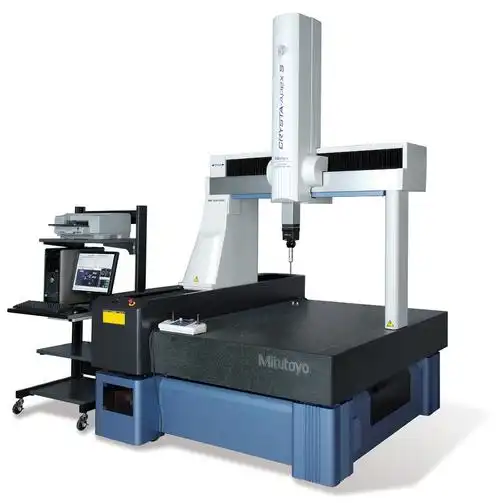
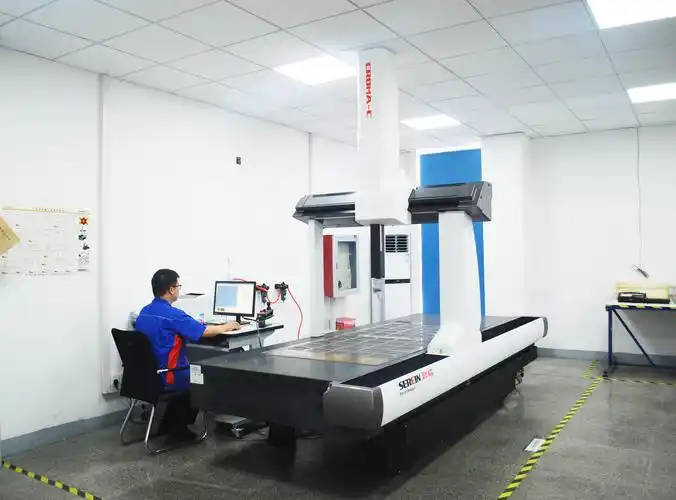





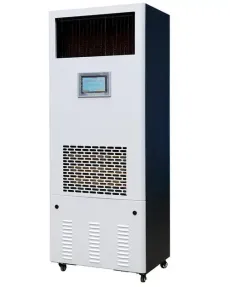
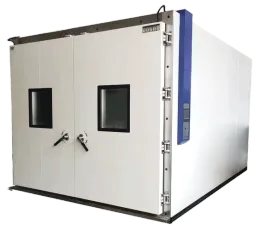

This high-precision scanning CMM has core technical advantages. It uses a zero-linear-error granite beam and ceramic shaft transmission structure, which can effectively reduce the influence of mechanical deformation on measurement accuracy. Equipped with Renishaw SP80 ultra-high speed scanning probe, the scanning speed can reach 1000mm/s, and the point density can reach 1 point per 0.1mm, realizing ultra-high precision detection of complex curved surfaces. The Calisoft Premium software supports micro-feature measurement, GD&T advanced analysis and nano-scale data processing, meeting the testing needs of semiconductor chip fixtures and precision medical devices. It has a built-in constant temperature control system to automatically adjust the environment temperature to 20±1℃, ensuring the stability of measurement accuracy.
This high-precision scanning CMM has ultra-precision technical specifications: the effective measurement range is 800mm (X-axis) × 600mm (Y-axis) × 500mm (Z-axis), with a maximum workpiece load capacity of 200kg. The X/Y/Z axis repeat positioning accuracy is ±0.2μm, and the comprehensive measurement accuracy is ±0.8μm, meeting the ISO 10360-2 international ultra-high precision measurement standard. The whole machine weighs 2800kg, with the workbench size of 900mm × 700mm, suitable for placing ultra-precision small parts. The power supply is standard 220V 50/60Hz 15A, and the required operating environment temperature is strictly controlled at 20±1℃, with relative humidity range of 45%-55%. The SP80 probe supports 0.01mm resolution scanning, meeting the detection needs of micro-scale features.
This high-precision scanning CMM is mainly applicable to semiconductor fixture manufacturing, precision mold processing, medical device production and aerospace precision parts processing industries. Typical application scenarios include dimensional inspection of semiconductor chip placement fixtures, curved surface accuracy detection of precision surgical instruments, size detection of micro-cutting tools, and assembly tolerance detection of aerospace precision bearings. In the semiconductor industry, it can detect the position accuracy of micro-through holes on chip fixtures to ensure the normal operation of chip production lines. In the medical device industry, it can detect the dimensional accuracy of titanium alloy surgical implants to meet the clinical matching requirements.







 Post RFQ


 Chat
Chat


 ALL CATEGORIES