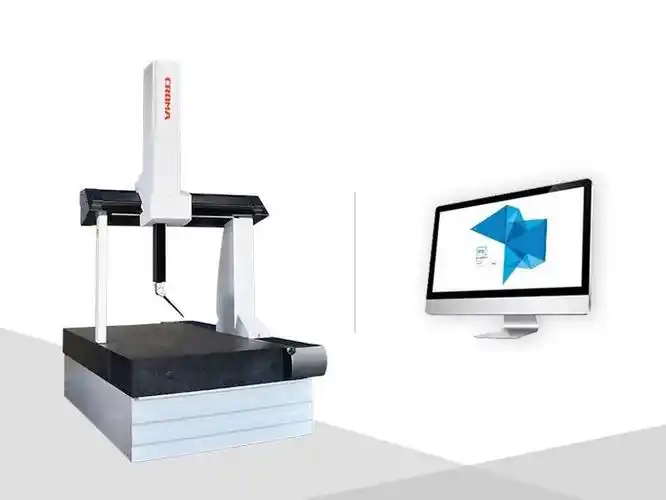
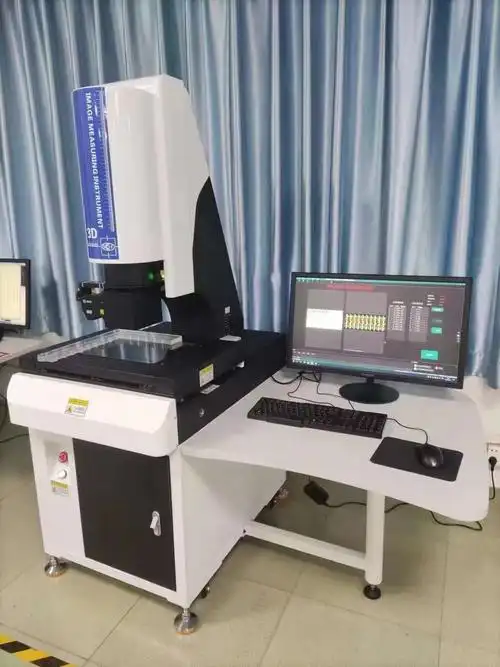






This non-contact scanning CMM features a high-speed laser scanning probe, which can collect 500 measuring points per second, greatly improving the detection efficiency of complex curved surfaces. It adopts a non-contact detection method, which will not cause any damage to the surface of the workpiece, making it suitable for detection of fragile and precision parts such as plastic shells and glass components. The built-in curved surface intelligent fitting algorithm can automatically complete the reconstruction of complex curved surfaces and generate accurate three-dimensional models. In addition, it supports multi-angle scanning and batch detection, which can meet the detection needs of different types of curved surface parts.
The specific technical specifications are as follows: The effective measurement range is X-axis 700mm, Y-axis 600mm, Z-axis 500mm; the overall measurement accuracy is ±1.0μm; the probe is a high-speed laser scanning probe, with a scanning range of 0-180 degrees; the maximum scanning speed can reach 500 measuring points per second; the matching measurement software is PC-DMIS Scan Pro, which supports complex curved surface fitting and three-dimensional model reconstruction; the workbench is made of natural Hanbian granite, with good stability; the maximum load capacity of the workbench is 800kg; the data interfaces include USB 3.0 and Gigabit Ethernet to support fast data transmission; the whole machine size is 1500mm × 1200mm × 1800mm; the power supply is 220V 50Hz/60Hz, and the protection grade is IP54; the curved surface fitting accuracy is ±0.5μm.
This product is widely used in 3C electronics, medical devices, precision injection molding, automobile interior parts and other industries. Typical application scenarios include dimensional detection of mobile phone shells, computer shells, medical device shells, automobile interior trim parts and complex curved mold profiles. It can also be used for reverse engineering of curved surface parts, providing accurate three-dimensional data for product redesign and mold manufacturing. In the 3C electronics industry, it can help enterprises quickly detect the dimensional accuracy of batch mobile phone shells, reducing the defect rate and improving production efficiency.







 Post RFQ


 Chat
Chat


 ALL CATEGORIES