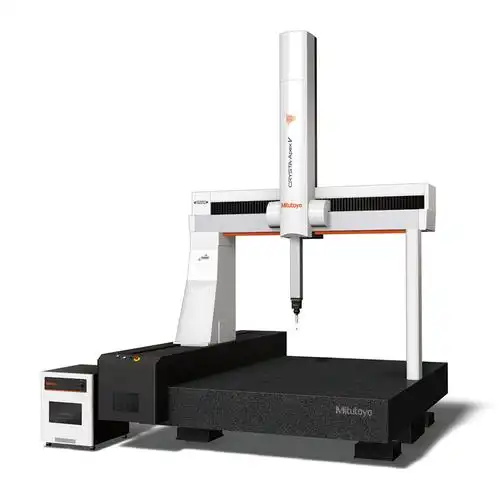
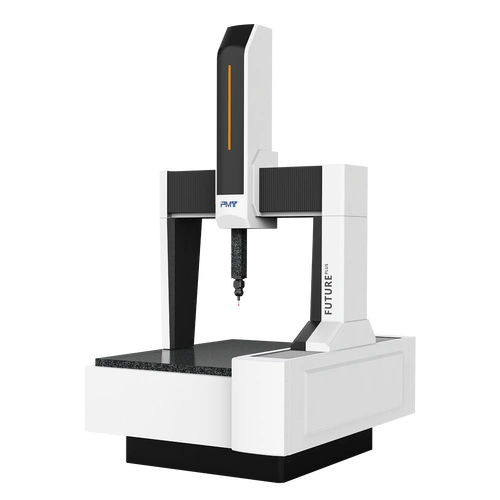






This small desktop bridge-type coordinate measuring machine (CMM) is designed for the inspection of small and medium-sized parts, making it suitable for compact workshops and university teaching laboratories. It has a space-saving compact structure while maintaining high-precision dimensional measurement performance. Compared with traditional manual measuring tools such as calipers and micrometers, it can efficiently and accurately detect the geometric tolerances and dimensional deviations of small hardware, electronic components and mini mould parts, helping to improve quality inspection efficiency and reduce manual measurement errors. It is a cost-effective inspection solution for small and medium-sized precision manufacturing enterprises.
This CMM has an X-axis stroke of 500mm, Y-axis stroke of 400mm, and Z-axis stroke of 300mm, with a measurement uncertainty of 2.5μm + L/300 (where L is the measured length in mm). It is equipped with a Renishaw SP25 contact probe, and runs on PC-DMIS Core 2024 professional measurement software. The recommended working environment is a temperature of 18-22℃ and humidity of 40%-60%RH. The power supply supports 110V/220V 50/60Hz, with a total host weight of 850kg. The overall dimensions are 1800mm (length) × 1500mm (width) × 1900mm (height), with an IP54 dust and water splash protection rating. It is equipped with USB3.0 and Gigabit Ethernet data interfaces, and the host is made of natural granite worktable and aluminum alloy bridge. It also supports automatic probe change function, with a probe change time of less than 8 seconds.
This small desktop CMM is widely applicable to small hardware processing factories, electronic component manufacturers, university teaching laboratories, and small-batch mold production enterprises. It can be used to detect dimensional and geometric tolerances of parts such as mobile phone casings, hardware gears, precision electronic connectors and plastic按键. It eliminates the need to move large workpieces to a professional inspection room, and can complete rapid and accurate inspection on-site, reducing handling costs and improving production inspection efficiency. It can replace traditional manual measurement tools, providing more accurate and reliable inspection data for product quality control, and helping enterprises reduce defective product rates.







 Post RFQ


 Chat
Chat


 ALL CATEGORIES