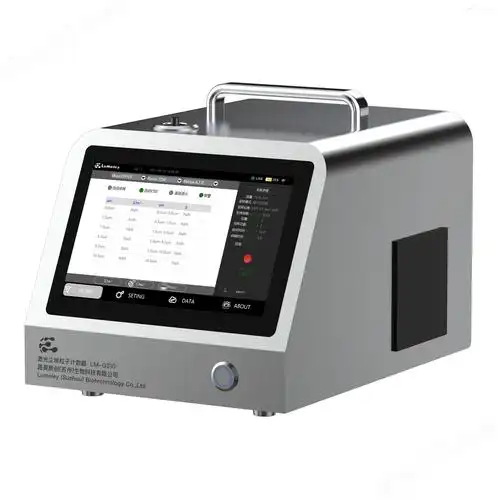


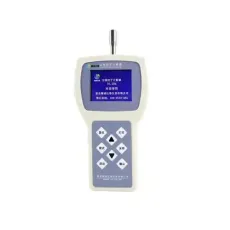
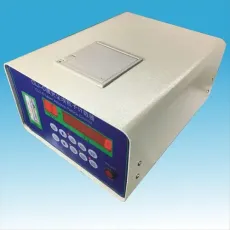
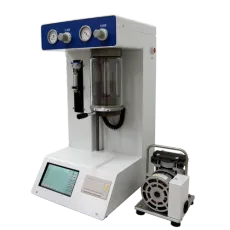
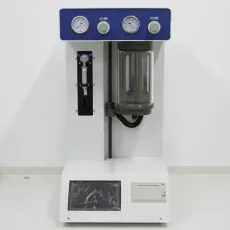
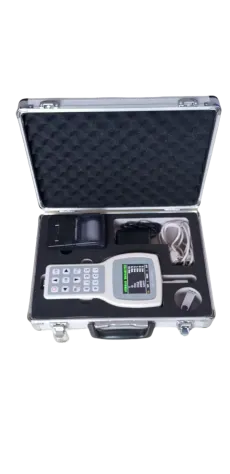
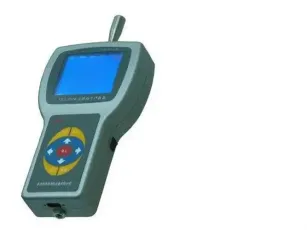
The core advantage of this product is its ultra-high detection accuracy and professional laboratory adaptation. It adopts a high-stability solid-state laser light source with a detection accuracy of ±3%, which meets the ISO 21501-4 and JIS Z 8907 testing standards. The aluminum alloy shell has good heat dissipation performance, ensuring the stability of the equipment during long-term continuous testing. It supports multiple communication interfaces such as USB, Ethernet and RS232, and can connect to professional laboratory information management systems for data synchronization and analysis. The 7-inch large touch screen supports professional data analysis functions such as particle size distribution histogram and trend chart. It has a noise level of less than 50dB, creating a quiet testing environment for the laboratory. Compared with similar products, it supports a maximum detection particle size of 100μm, meeting the testing needs of ultra-fine particle research.
This lab-grade particle counter has 12 standard particle size detection channels: 0.05μm, 0.1μm, 0.2μm, 0.3μm, 0.5μm, 1μm, 2μm, 3μm, 5μm, 10μm, 25μm and 100μm. The sampling flow rate is accurately controlled at 1.0L/min, which meets the high-precision testing standards of international laboratories. The 7-inch IPS touch screen has a resolution of 1024*768, supporting professional data analysis and report generation. The equipment is made of aluminum alloy, with an overall size of 400mm (length) ×300mm (width) ×200mm (thickness) and a net weight of 8.5kg. It supports operating temperature range of 18℃-28℃ and humidity range of 10%-95%RH (no condensation), and has passed CE and ISO 17025 certifications, meeting the testing requirements of national first-class laboratories.
This product is suitable for high-precision particle detection in semiconductor manufacturing workshops, biomedical material research, nano material research, environmental monitoring laboratories, and pharmaceutical production quality testing. It can meet the testing requirements of ISO 14644, GMP, SEMI and other industry standards, and provides accurate data support for scientific research and production quality control. It is also suitable for colleges and universities to carry out cutting-edge research on ultra-fine particles and air quality.








 Post RFQ


 Chat
Chat




 ALL CATEGORIES