
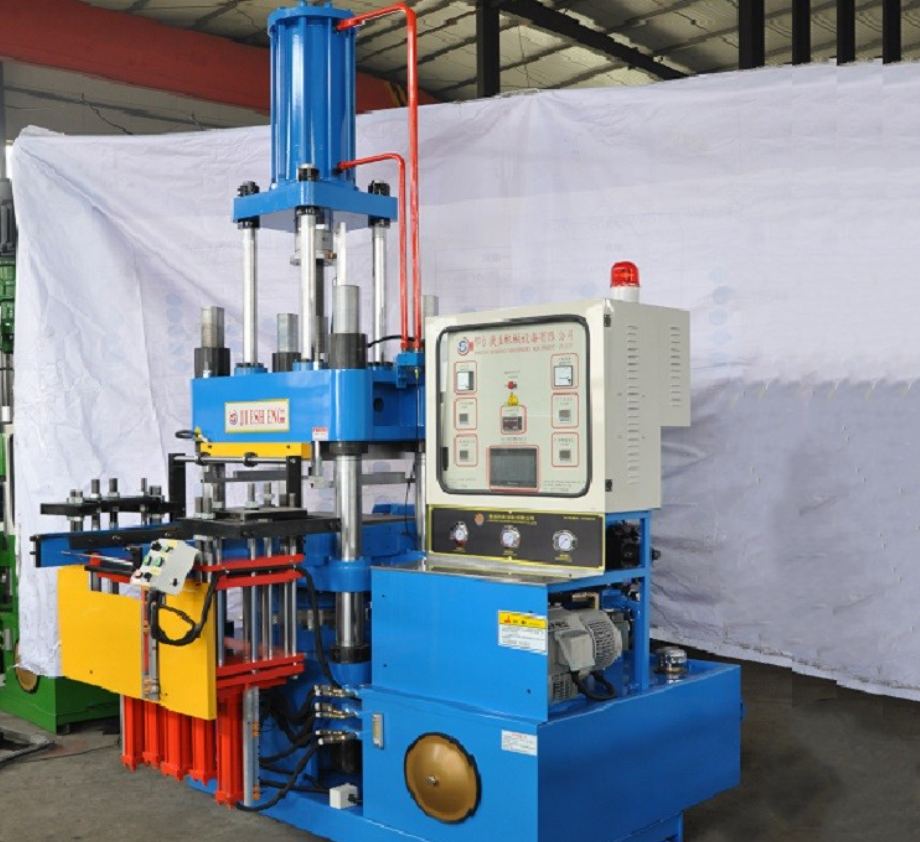





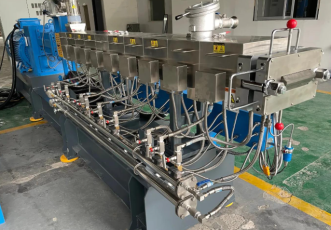
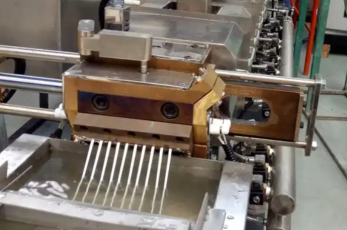
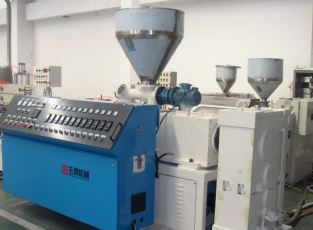


The core characteristic of a ram extruder lies in its unique"solid compaction conveying"and shear-independent forming mechanism.By applying enormous and uniform hydrostatic pressure to the material,it induces plastic deformation and limited viscous flow under high pressure,achieving densification and forming at relatively low temperatures.This principle fundamentally avoids the high temperatures generated by screw shear,effectively preventing molecular chain degradation in materials such as UHMWPE and PTFE.The equipment features a robust structure with extremely high rigidity to withstand significant periodic alternating loads.Its process allows precise control over the pressure profile,holding time,and thermal history for each forming cycle,ensuring highly uniform product density,minimal internal stress,and excellent physical properties.Although it typically operates in batch mode with lower absolute production efficiency compared to continuous screw extruders,it specializes in processing materials that are unmanageable by the latter.
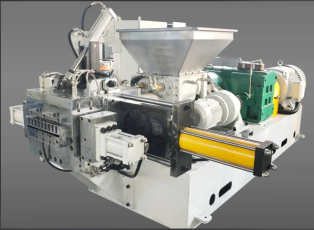
Standard specifications cover a series from laboratory to industrial scales.Taking a medium-sized industrial servo-driven ram extruder as an example:It employs a high-precision ball screw and servo motor to provide thrust,allowing precise,fast-responding,energy-efficient,and clean force control.The barrel is typically divided into feeding,compression,and homogenizing zones,each with an independent PID temperature control module for precise regulation,achieving accuracy up to±1°C.It is equipped with high-precision displacement and pressure sensors for real-time monitoring of plunger position and cavity pressure,forming a closed-loop control system.The control system can store hundreds of process recipes for different materials and products and can completely record the pressure-displacement-time curve for each extrusion cycle for quality traceability and process analysis.Safety features include multiple mechanical limits,pressure overload protection,and electrical interlocks.The entire machine foundation requires special reinforcement to absorb the tremendous reaction forces.
The ram extruder finds its primary applications in specialized fields involving materials deemed difficult or impossible to process with conventional extrusion methods.Its key uses include manufacturing wear-resistant and high-impact products from Ultra-High Molecular Weight Polyethylene(UHMWPE),such as sheets for industrial liners and medical implants,rods,pipes,and profiles.It is also essential for the pre-forming of Polytetrafluoroethylene(PTFE)into seals,gaskets,and other components,producing dense green bodies for subsequent sintering.Furthermore,it is employed in powder metallurgy and advanced ceramics to extrude complex-shaped green bodies from metal or ceramic powder feedstocks,which are later sintered into final parts.Additionally,it processes other high-viscosity engineering plastics(e.g.,PEEK,PI)and high-filler composites,and finds niche uses in producing solid lubricants,graphite electrodes,propellant grains,and thermoset pre-forms.







 Post RFQ


 Chat
Chat


 ALL CATEGORIES