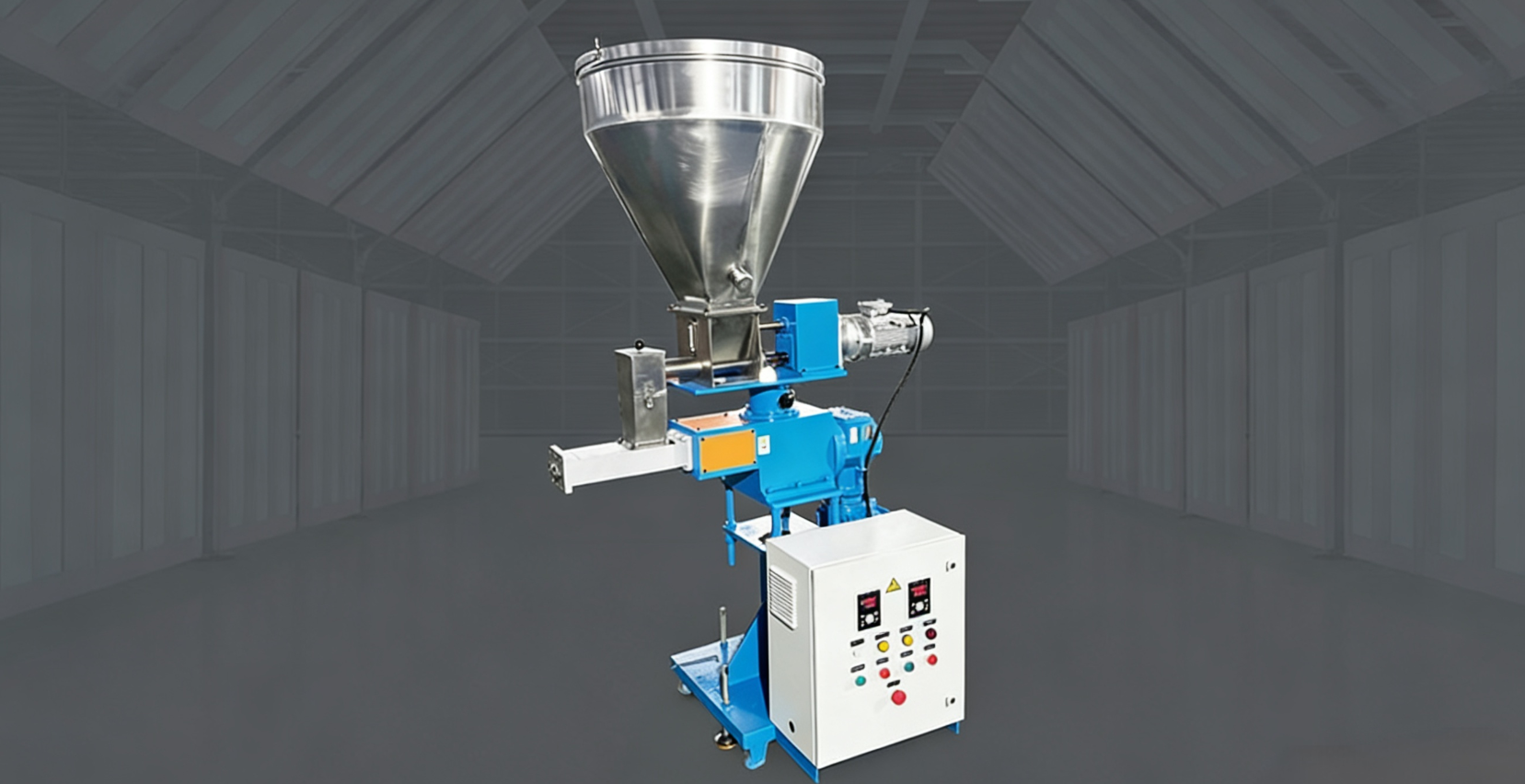
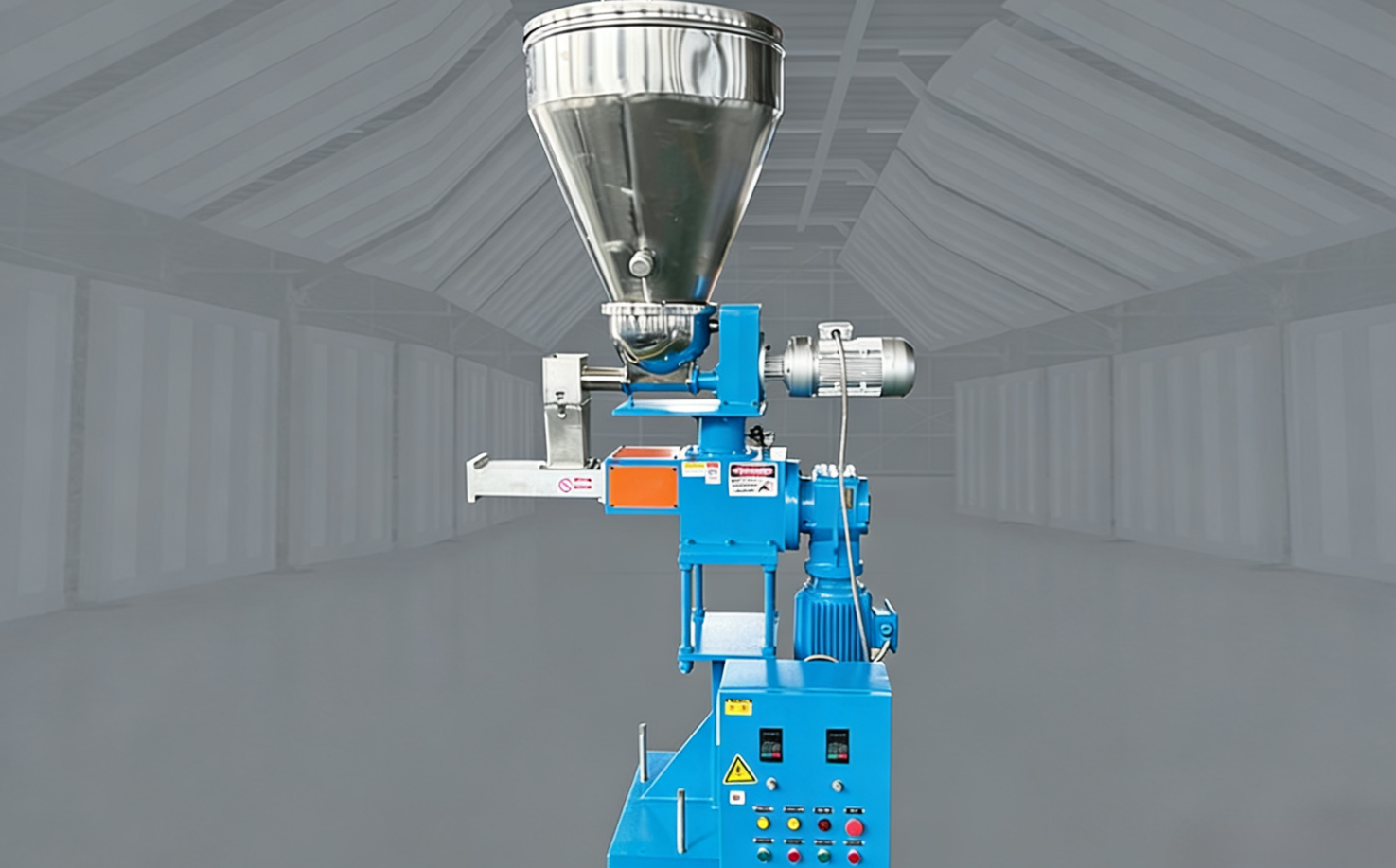





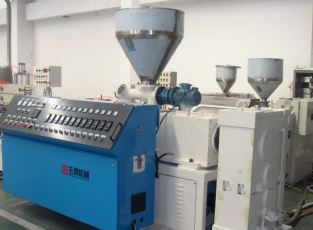


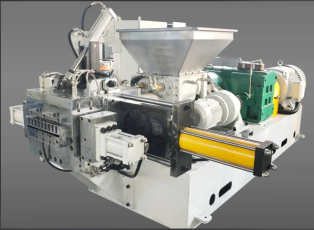
The core feature of a side feeder lies in its forced positive displacement conveying capability and synchronization with the main process.It uses a rotating screw within a closed barrel to generate powerful axial thrust,overcoming bridging and clogging caused by fillers with low density or high cohesiveness.This ensures stable"pushing"of material into the main extruder barrel,which is under high pressure.To match the ever-changing conditions of the main extruder,its drive system(especially servo or vector VFD)must have fast response and precise speed/torque control capabilities,achieving strict proportional synchronization with the main screw speed or output.High-end models utilize loss-in-weight metering,which provides closed-loop feedback control by monitoring real-time hopper weight changes.This achieves dynamic accuracy up to±0.25-0.5%,completely eliminating errors from material bulk density variations and is key to achieving high-precision compounding.
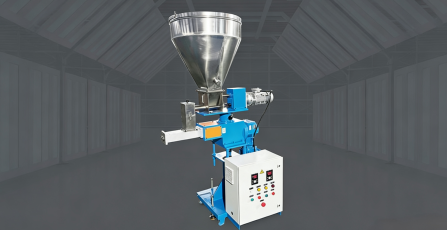
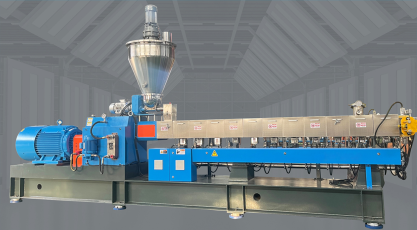
A standard side feeder consists of several major systems:The Feeding System,including a hopper with bridge-breaking devices,a wear-resistant screw,and barrel.The Drive System,typically a servo motor or high-performance VFD motor with encoder feedback,driving the screw via a gear reducer.The Frame&Connection System,a robust support structure and a connection flange with water cooling channels to ensure a stable interface with the main extruder and prevent feeding port blockage from heat transfer.The Control System,which can be a local operator panel or fully integrated and controlled by the main extruder's PLC.For processing highly abrasive materials like glass fibers,screws and barrel liners are often made from bimetallic alloys or coated with special ceramics,extending service life several times over.The equipment is typically well-sealed to prevent dust leakage and designed with convenient access panels for maintenance.
The side feeder is a critical component in continuous polymer compounding processes,specifically designed to enable the stable and precise introduction of large volumes of solid fillers or reinforcements.Its primary applications include:the production of highly filled composites,such as calcium carbonate or talc-filled PP/PE masterbatches,where it achieves filler loading ratios up to 80%while ensuring uniform dispersion;serving as the standard method for manufacturing glass fiber reinforced engineering plastics(e.g.,PA,PP,PBT),allowing effective control over fiber length and distribution;enabling the stable and continuous feeding of biomass fillers like wood flour in wood-plastic composite(WPC)production;facilitating the blending of flake or fibrous recycled materials as a secondary stream;and introducing functional powders such as flame retardants or pigments through the side port in specific formulations to optimize dispersion and prevent contamination in the main feed throat.This equipment is particularly adept at handling materials with low bulk density,a tendency to bridge,or high abrasiveness,making it a core component for achieving complex,high-performance compounding production.







 Post RFQ


 Chat
Chat


 ALL CATEGORIES