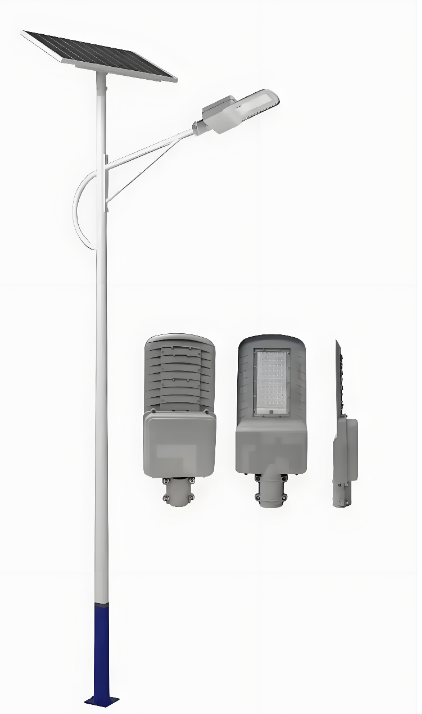
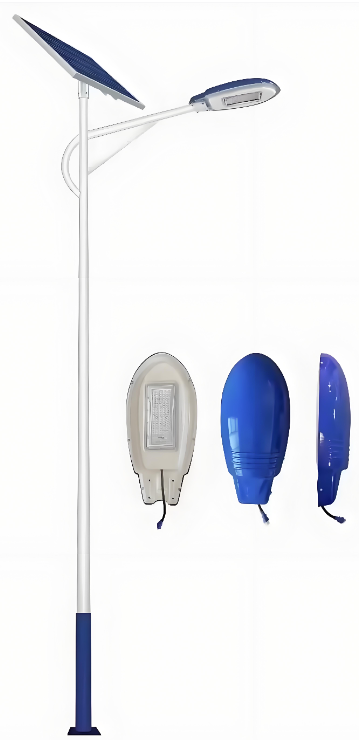






The pole’s main body is made of Q235 carbon steel with electrophoresis treatment, which enhances adhesion between the base material and powder coating, preventing peeling and rusting in high-humidity environments. The 300W monocrystalline silicon solar panel has a conversion efficiency of up to 23.5%, which is 5% higher than ordinary polycrystalline panels, enabling faster energy storage in low-light conditions. The built-in 120Ah lithium iron phosphate battery has a cycle life of over 2000 times, avoiding the memory effect of lead-acid batteries and extending the replacement cycle to 8 years. The intelligent control system supports remote monitoring and brightness adjustment via mobile app, allowing managers to optimize lighting schedules based on actual needs. Additionally, the pole’s octagonal structure provides better stability than cylindrical poles, reducing the risk of tilting in uneven terrain installation scenarios.
The pole has an overall height of 8000mm, with a tapered octagonal cross-section ranging from 220mm at the base to 150mm at the top, and a uniform wall thickness of 4.5mm. The direct burial depth is 1200mm, requiring a concrete backfill of C25 grade to ensure stability. The solar panel measures 1650*990mm, with an IP67 protection rating, suitable for outdoor rain and dust environments. The LED street light has a power of 60W, a luminous flux of 8000lm, and a color temperature of 6500K, meeting national road lighting standards (GB/T 24907-2010). The lithium battery is housed in a waterproof aluminum alloy box with an IP65 protection rating, installed 200mm above the ground to avoid water immersion. The total weight of the pole is approximately 220kg, with a wind resistance grade of 10, capable of withstanding gusts of up to 118km/h.
This integrated solar octagonal pole is ideal for rural village roads, suburban bike lanes, remote scenic area trails, industrial park peripheral roads, and coastal fishing villages. In rural areas without grid coverage, it provides independent lighting for villagers’ nighttime travel, improving safety and quality of life. In scenic spots, its pure white appearance blends with natural landscapes, and the off-grid design avoids damaging the ecological environment with wiring construction. In industrial parks, it serves as auxiliary lighting for parking lots and peripheral roads, reducing reliance on grid power and lowering energy costs. It can also be used in emergency lighting scenarios, such as temporary construction sites or disaster-stricken areas, as it can be quickly installed and put into operation without grid support. Additionally, it supports modular upgrades, allowing users to replace higher-power solar panels or batteries to meet changing lighting demands.










 Post RFQ


 Chat
Chat


 ALL CATEGORIES