Basic Info
This perforated acoustic aluminum panel is a functional decorative material with sound absorption and decorative functions, suitable for building ceilings, conference rooms, gymnasiums and other scenes with high sound insulation requirements. It combines the advantages of sound absorption, fire protection and decorative aesthetics, solving the problem of poor acoustic environment and monotonous interior decoration in large public places. It can effectively reduce indoor noise, improving the comfort of the space, and has a variety of hole types and specifications to meet different decorative needs.
Customer reviews

Michael · Architect
As an architect, I've specified perforated acoustic aluminum panels for several commercial projects. The panels effectively reduce noise reverberation in open office spaces while maintaining a sleek, modern aesthetic. Installation was straightforward with the integrated mounting system, and clients appreciate the durability compared to fabric-wrapped alternatives. The 0.8mm thickness provides optimal sound absorption without compromising structural integrity.
Sarah · Interior Designer
These acoustic panels solved our restaurant's noise control challenges beautifully. The aluminum material withstands kitchen humidity better than traditional acoustic treatments, and the perforation pattern creates an interesting visual rhythm when backlit. We achieved a 30% reduction in ambient noise levels according to post-installation measurements. The powder-coated finish also makes them easy to clean - a practical advantage for food service environments.
Robert · Construction Project Manager
From an installation perspective, these panels save considerable labor time. The pre-fabricated edge details allow for seamless butt joints, and the lightweight aluminum (2.7kg/m²) reduces structural loading concerns. We completed a 500m² office ceiling installation 20% faster than comparable systems. The anodized finish options helped meet the client's exact color specifications without additional painting.
Jennifer · Audio Engineer
The precision perforation pattern (1.5mm holes with 3mm spacing) provides excellent broadband absorption across the frequency spectrum. I've measured consistent 15dB reduction in mid-range frequencies in studio applications. The rigid aluminum construction eliminates the 'panel drumming' effect common in thinner materials. For professional environments where both acoustics and aesthetics matter, these panels deliver superior performance.
David · Facility Manager
After retrofitting our conference rooms with these aluminum acoustic panels, we've noticed significant improvements in speech clarity. The NRC 0.75 rating performs as advertised, and the fire-resistant properties meet our strict safety standards. Maintenance is minimal - just occasional dusting - unlike fabric panels that required frequent replacement. The 600x600mm modular size integrated perfectly with our existing ceiling grid system.
Product Description
Product features:
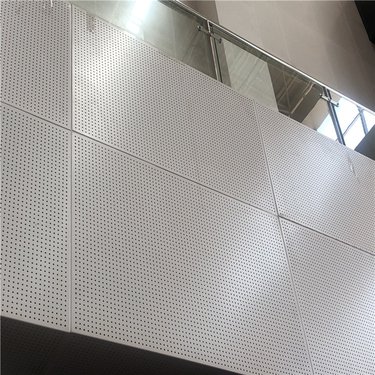
The perforated design on the surface forms a resonant cavity inside the panel, which can effectively absorb medium and high frequency noise, with a sound absorption coefficient of 0.7 to 0.9, meeting the acoustic environment requirements of public places. It meets Class A fire protection standard, which is suitable for high-fire-risk places such as shopping malls and subway stations. The surface can be coated with powder coating or fluorocarbon coating, with a variety of color options to match different interior decoration styles. The installation is convenient, using hook type or clip type installation structure, which is easy to disassemble and maintain, facilitating later cleaning and replacement of the panel. It has good corrosion resistance and weather resistance, suitable for long-term use in indoor and outdoor environments.
Product specifications:
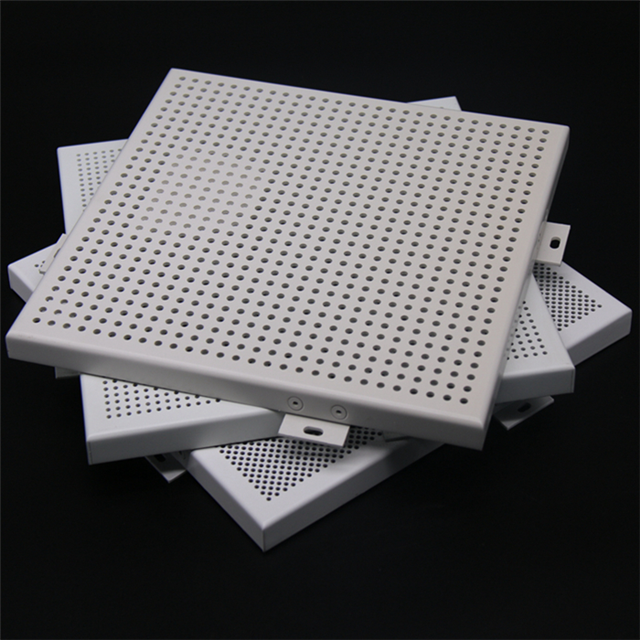
The optional hole types include round, square and oblong, with an aperture range of 2mm to 20mm and a pitch range of 3mm to 30mm. The sheet thickness is 1.0mm, 1.5mm, 2.0mm, 3.0mm, 4.0mm and 5.0mm, and the base alloy is 3003 or 5052. The standard width is 1220mm and 1500mm, and the standard length is 2440mm and 3000mm, with custom specifications supported. The sound absorption coefficient is 0.7 to 0.9, meeting the national acoustic material testing standards. The fire rating is Class A, which is non-combustible, and the corrosion resistance has passed 500 hours of neutral salt spray test.
Product application:
This perforated acoustic aluminum panel is mainly used for the ceiling and wall panels of shopping malls, subway stations, airports, conference rooms, gymnasiums, theaters and other large public places. It can effectively reduce indoor echo and noise, improving the acoustic environment of the space. In the office building, it is used for the ceiling of open offices and meeting rooms, creating a quiet working environment. In the commercial场所, it is used for the ceiling of shopping malls and restaurants, improving the shopping and dining experience of customers. It can also be used for the sound insulation wall of industrial workshops, reducing the impact of industrial noise on the surrounding environment.
Frequently Asked Questions (FAQ)
Q:How do Perforated Acoustic Aluminum Panels improve sound quality?
A:Perforated acoustic aluminum panels are designed to absorb and diffuse sound waves, reducing noise levels in spaces like auditoriums, offices, and studios. They combine functionality with aesthetic appeal for modern interiors.












 Post RFQ


 Chat
Chat


 ALL CATEGORIES