Basic Info
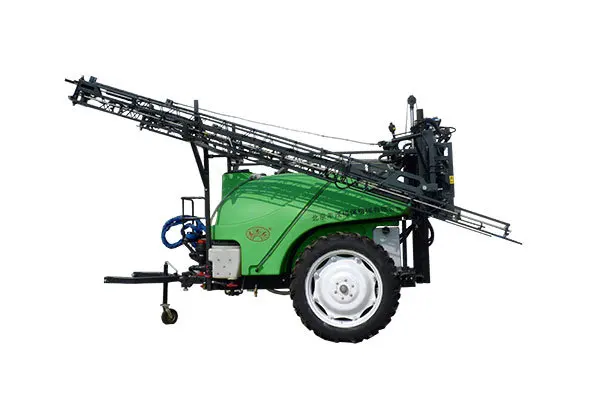
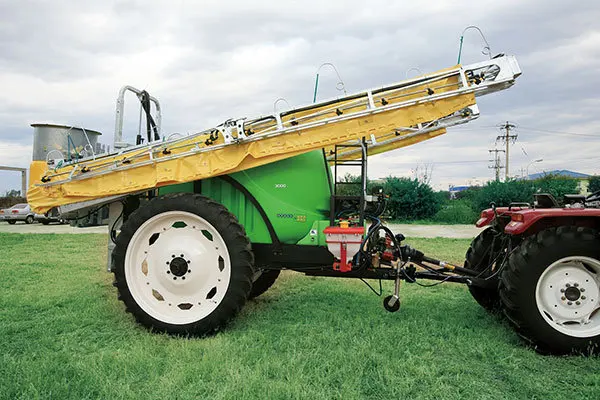
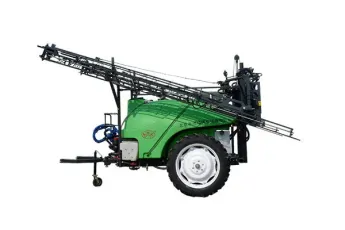
An ultra-large boom sprayer towed by a high-horsepower tractor.Features a massive tank and an extremely wide boom for covering vast areas in a single pass.A Powerful Tool for Plant Protection for achieving greater efficiency on Large-scale farms in flat regions.
Product Description
Product Features
Enormous tank volume minimizes field refill stops.Ultra-wide boom with multiple hydraulic folding sections;equipped with advanced gyroscopes or tilt sensors for automatic boom contour following and balancing.Advanced flow control system for precise variable rate application.Individual nozzle or boom section control(Section Control)to avoid overlap or misses.
Product Specifications
Many boom sections(7+).High-flow diaphragm or centrifugal pump.Sturdy tow hitch with independent suspension/dampening.Can integrate RTK-GPS for cm-level guidance.
Product Application
Specifically designed for vast farms in regions like the US,Canada,Australia,Eastern Europe,and Northeast China,growing crops like wheat,corn,soybeans,rapeseed,and alfalfa.Aimed at completing plant protection on tens of thousands of acres within the shortest weather windows,demanding extremely high efficiency and reliability.
Frequently Asked Questions (FAQ)
Q:How wide is the spray boom of a large tractor-trailed boom sprayer?
A:The boom utilizes hydraulic folding technology, with a maximum working width reaching 24 to 36 meters. This increases the coverage area per pass, making it key equipment for efficient crop protection on large farms.
Q:How does the large tractor-trailed boom sprayer ensure uniform application on undulating terrain?
A:The boom is equipped with an advanced independent hydraulic suspension or mechanical contour-following system. It automatically adjusts the height of each section according to ground contours, ensuring consistent nozzle height above ground for even chemical distribution.
Q:How does the large tractor-trailed boom sprayer achieve precision variable-rate application?
A:By integrating GPS, flow sensors, and a controller, it can automatically adjust the application rate based on a preset prescription map or real-time travel speed, enabling on-demand spraying and saving 15%-30% on chemicals.
Q:What is the tank capacity of this sprayer, and does it require frequent refilling?
A:The standard tank capacity is 2000 to 3000 liters. This capacity significantly reduces the number of field refills, ensuring continuous operation capability and improving overall work efficiency.
Q:Is connecting the large tractor-trailed boom sprayer to the tractor convenient?
A:It uses a standard three-point hitch and quick-connect electrical/hydraulic couplers. A single operator can complete the hook-up to a tractor meeting the horsepower requirements (typically over 100 HP) within minutes, offering Convenient and high efficiency.
Q:How does its filtration system prevent nozzle clogging?
A:It is equipped with a three-stage filtration system (tank suction filter, main line filter, boom-end filter) and features an automatic backflush function. This effectively filters out impurities, greatly reducing the risk of nozzle clogging.













 Post RFQ


 Chat
Chat


 ALL CATEGORIES