Basic Info
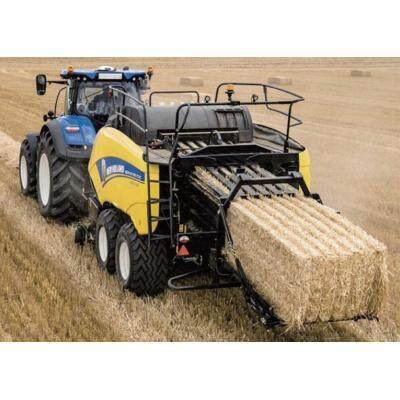
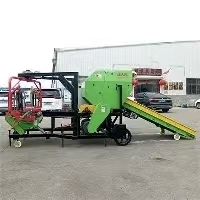
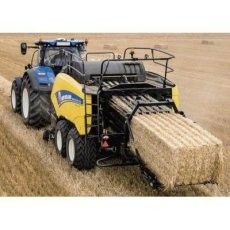
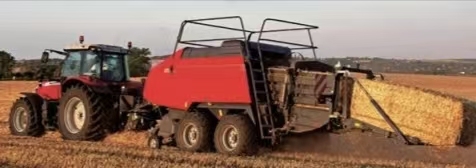
The Case IH LB434 R16 belongs to the stationary large square baler category.Its core feature is a fixed-size bale chamber that uses a powerful pre-compression and main plunger system to compress crop material into high-density large square bales.This type of machine is often suited for large-scale commercial operations where maximum bale density and transport economy are key considerations.The"container-friendly"bales it produces can offer advantages for long-distance transport and export trade.
Product Description
Features
The machine utilizes a"fixed chamber"design.Crop material undergoes pre-compression before entering the main chamber,which can contribute to forming bales with neat edges and uniform density.The"R16"designation indicates a 16-twine knotter system designed to ensure the structural integrity of high-density bales during handling.It typically features a high-capacity feeding system with large feed forks to manage heavy crop flow.An advanced electronic control system monitors and adjusts feed rate,density,and tying processes.
Specifications
It comes standard with a heavy-duty pickup,often 3.05 meters wide,or can be configured for direct in-line coupling with large mower-conditioners.Bale length is infinitely adjustable from 0.8 to 2.4 meters to suit various transport and storage needs.Achievable bale density can exceed 200 kg/m³,with individual bale weights commonly ranging from 500 to 800 kg.It requires a tractor with a 1000 rpm PTO and significant hydraulic output.The overall structure is exceptionally robust to withstand continuous high-pressure operation.
Applications
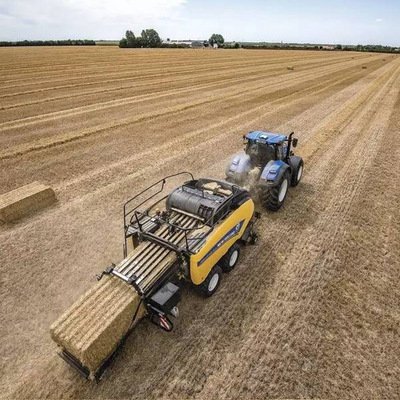
Primary users are large commercial hay exporters,very large dairy farms,and biomass energy plants(e.g.,for straw recovery).The 1.2-meter wide large square bales can be packed tightly into standard shipping containers or flatbed trailers,maximizing load space and potentially reducing per-unit transport costs.The high density also makes bales more weather-resistant for field storage and can help maintain silage quality during fermentation when used for silage.
Frequently Asked Questions (FAQ)
Q:Is a stationary large square baler suitable for direct use on pastures?
A:Yes,highly suitable.Stationary balers typically feature high power and capacity,and can be set up directly at centralized collection points or near silos on pastures to process gathered forage or straw.They produce dense(over 250 kg),uniform large square bales,significantly optimizing subsequent loading and long-distance transport efficiency.
Q:What is the main advantage of a stationary large square baler?
A:Its primary advantage is the production of extremely dense,uniformly sized large square bales,typically weighing 500-900 kg each.This high density significantly enhances transport and storage efficiency,making it ideal for large ranches,biomass energy companies,and users requiring long-distance forage transport.
Q:What site and infrastructure are required for this equipment?
A:A solid,level concrete foundation and reliable 380V three-phase industrial power are essential.The site must have ample space for raw material storage and finished bale storage,and be equipped with heavy-duty forklifts(5+ton capacity)for handling.A well-designed material conveying system(e.g.,conveyor belts)can further improve operational smoothness.
Q:What are its production capacity and energy consumption?
A:Capacity varies by model and material,typically processing 10-25 tons of dry hay per hour,producing 8-15 high-density large square bales.As a stationary electric machine,its energy consumption is more stable and economical compared to towed equipment,with generally lower energy cost per unit of output,though industrial electricity rates must be considered.
Q:What types of agricultural materials is it suitable for processing?
A:It is primarily suitable for dry hay,straw,and wheat straw.It can also process some biomass materials like corn stover or reeds after proper drying.It has strict requirements for material moisture,typically below 15%,to ensure bale quality and prevent mold.
Q:Is maintenance complex?What are the core components?
A:Maintenance is more centralized but requires higher expertise compared to towed models.Core components include the heavy-duty baling chamber,hydraulic system,electronic control system,and knotter.Regular lubrication,checking hydraulic fluid and electrical connections,and keeping knives sharp are crucial.Annual major servicing by professional technicians is recommended.












 Post RFQ


 Chat
Chat


 ALL CATEGORIES