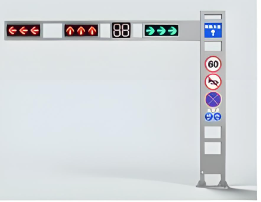
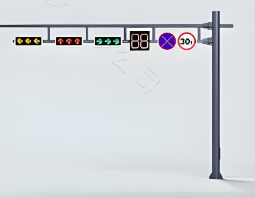





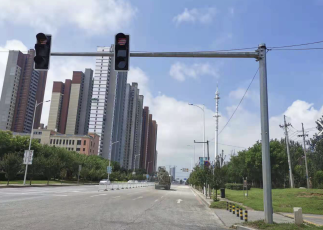
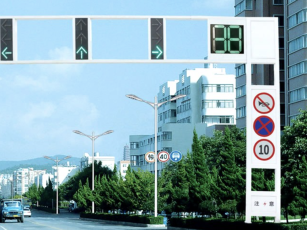
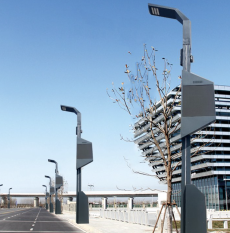
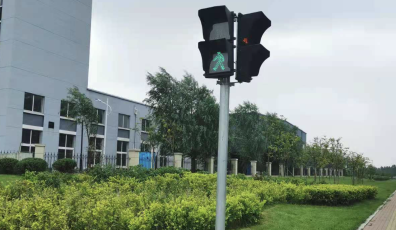
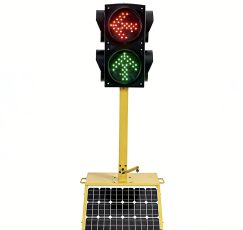
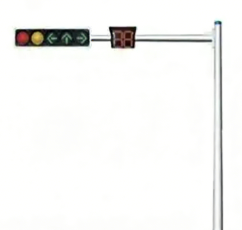

The octagonal pole structure distributes wind load more evenly than cylindrical poles, withstanding gusts up to 140km/h with a 1.6 safety factor, making it suitable for storm-prone regions. Its integrated 300W monocrystalline solar panel delivers 22% energy conversion efficiency, ensuring sufficient power generation even in low-light conditions. The 12V/100Ah lithium-ion battery offers a 5+ year lifespan, providing reliable energy storage for continuous signal operation during cloudy days or nighttime. The intelligent LED controller enables remote monitoring via LTE/NB-IoT, allowing traffic management teams to adjust signal timings based on real-time data to reduce congestion. Unlike traditional traffic poles requiring costly underground wiring, this off-grid model cuts installation costs by 60% in remote areas. With an IP65 rating, it resists dust and water damage, ensuring uninterrupted operation in all weather conditions. The combination of galvanized steel and aluminum alloy components balances durability and lightweight design, facilitating easy transportation and installation.
Height options include 8m and 10m variants, with a top diameter of 100mm and bottom diameters of 200mm (8m) and 220mm (10m). Wall thickness is uniformly 4mm across both heights, ensuring structural rigidity without excessive weight. The 300W monocrystalline solar panel measures 1650x990mm, with 22% conversion efficiency to power 4 traffic signal heads and pedestrian lights. The 12V/100Ah lithium-ion battery is housed in a weatherproof aluminum enclosure, with an 80% depth of discharge to extend lifespan. The intelligent controller supports remote signal adjustment, fault diagnosis, and energy consumption monitoring via a cloud platform. Wind resistance is tested to 140km/h, meeting international structural safety standards. Flange plates are 400x400mm (8m) and 450x450mm (10m), with 6 M20 bolts for secure anchoring. All electronic components are CE and FCC certified, while the pole structure adheres to ISO 14001 environmental standards.
Perfect for off-grid traffic control in rural intersections, temporary construction sites, remote highway rest areas, and mountainous road crossings where grid power is unavailable or costly to install. Urban areas use it for temporary traffic management during road construction or special events, avoiding the need for temporary wiring. Coastal regions and areas with frequent power outages rely on it to ensure uninterrupted traffic signal operation during storms or blackouts. Transportation departments leverage its remote monitoring features to optimize traffic flow in peak hours, reducing congestion and improving road safety. It integrates with smart city IoT systems to collect real-time traffic data and adjust signal timings automatically. Industrial zones and logistics hubs with private road networks install it to manage internal traffic flow without relying on the public grid.








 Post RFQ


 Chat
Chat




 ALL CATEGORIES