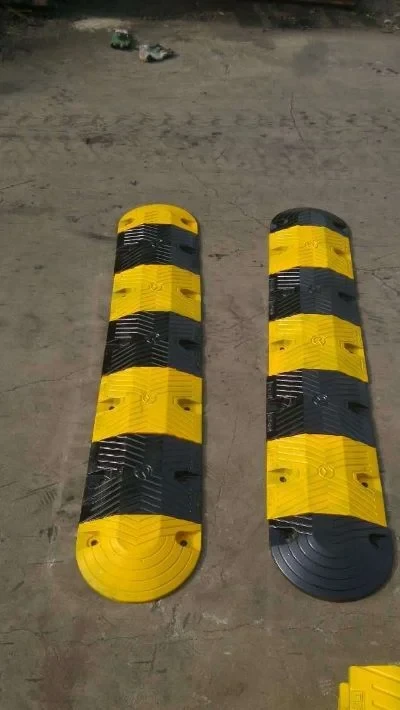
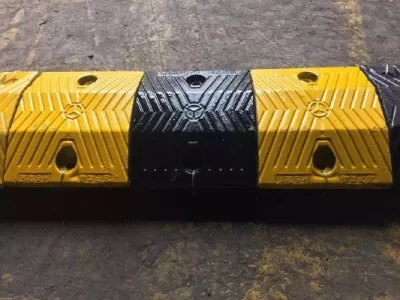





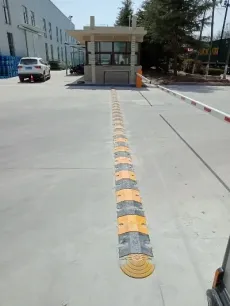
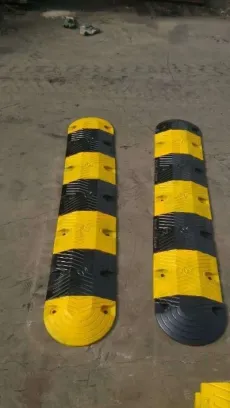
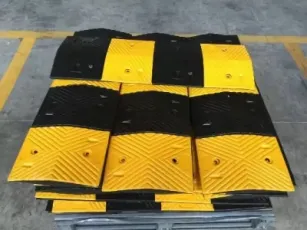
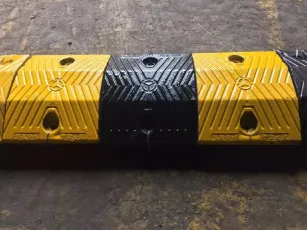
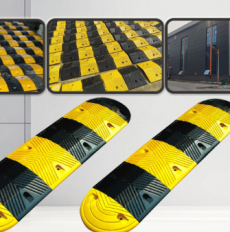
The core strength of this speed bump is its exceptional load-bearing capacity, solving the problem of traditional light-duty speed bumps deforming or breaking under heavy truck traffic. The QT450-10 ductile iron material undergoes a quenching and tempering process, enhancing its tensile strength to 450 MPa, which is 2-3 times higher than ordinary rubber speed bumps. The powder coating is applied via electrostatic spraying, forming a 60μm thick protective layer that resists rust, corrosion, and fading, maintaining high visibility for over 3 years. The surface features anti-slip tooth patterns, increasing tire friction to prevent skidding even when vehicles pass through at higher speeds. Unlike prefabricated rubber bumps, it can be customized with reflective strips for enhanced nighttime visibility, and its pre-embedded design ensures stable performance even in areas with soft subsoil. Additionally, it requires minimal maintenance, with only periodic bolt checks needed to ensure safety.
This speed bump measures 1000mm in length, 400mm in width, and 70mm in height, with a dimensional tolerance of ±1mm to meet strict industry standards. Made from QT450-10 ductile iron, it has a Brinell hardness of 160-210 HB, balancing toughness and wear resistance. The powder coating has a glossiness of 80±5 units and adheres to the iron surface with a pull-off strength of ≥5 MPa, ensuring no peeling or chipping. Its static load capacity reaches 50 tons, and dynamic load testing shows no deformation after 100,000 passes of 40-ton trucks. Pre-embedded installation requires a 150mm deep foundation, with 4 M16 expansion bolts providing firm fixation. It operates effectively in temperatures ranging from -50℃ to 70℃, suitable for use in cold northern regions and high-temperature desert areas. The product complies with ASTM E119 fire resistance standards and national traffic facility safety regulations.
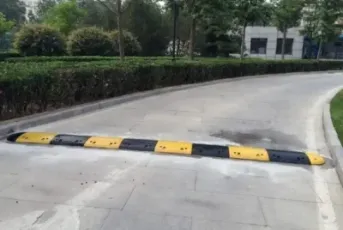
This heavy-duty speed bump is primarily used in traffic zones with frequent heavy vehicle passage. At highway interchanges and toll stations, it enforces speed limits to reduce rear-end collisions and improve traffic order in merging and diverging lanes. In logistics parks and freight terminals, it is installed on main roads and loading dock entrances to slow down trucks, preventing accidents involving pedestrians and forklifts. It is also ideal for mining areas, construction sites, and industrial parks, where heavy machinery and dump trucks operate daily, ensuring safe speed control without frequent replacement. Additionally, it can be used in port areas and railway freight yards, where salt spray and harsh weather conditions demand corrosion-resistant and durable traffic management solutions. Its high visibility ensures that drivers, even those operating large vehicles with limited visibility, can detect it in advance and slow down appropriately.













 Post RFQ


 Chat
Chat


 ALL CATEGORIES