




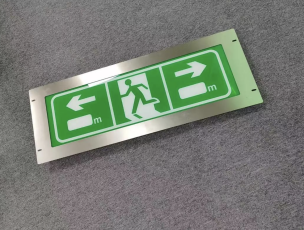
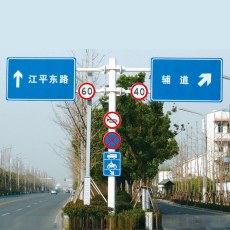
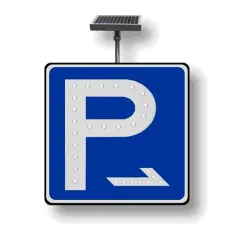
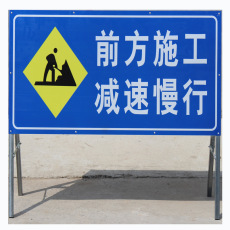
The product’s core advantage is its passive photoluminescent technology, which absorbs natural or artificial light during the day and emits a bright green glow for over 12 hours in dark environments, solving the pain point of traditional reflective signs being invisible in complete darkness without vehicle headlights. The tempered glass substrate is 5mm thick, providing exceptional impact resistance to withstand falling branches, rocks, and accidental vehicle impacts in mountainous areas. Its EN 12899-1 Class RA1 reflective grade ensures visibility during the day, while the photoluminescent coating complies with ASTM E2072 standards, providing consistent luminous intensity throughout the night. The IP65 protection grade resists rain, dust, and temperature fluctuations, making it suitable for rural environments with extreme weather conditions. Additionally, its low-maintenance design requires no power supply or regular replacement, reducing long-term operational costs.
Measuring 500mm in width and 500mm in height, the sign weighs 10kg, with a galvanized steel mounting column that can be installed at a height of 1.5-2 meters along the roadside. The tempered glass substrate has a transmittance of 90%, ensuring maximum light absorption for the photoluminescent coating. The coating has a luminous intensity of 100mcd/m² after 12 hours in darkness, meeting the visibility requirements for rural road contour signs. The reflective layer under the photoluminescent coating has a minimum retroreflection coefficient of 100cd·lx⁻¹·m⁻² for white, ensuring daytime visibility. The mounting column is 1500mm tall with a diameter of 60mm, coated with anti-corrosion paint to withstand rural humidity and soil corrosion. All components comply with China’s GB 5768 road traffic sign standards and European CE standards.
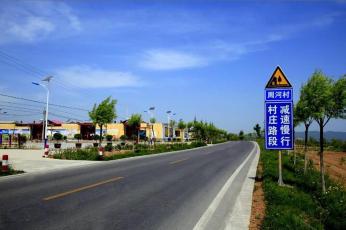
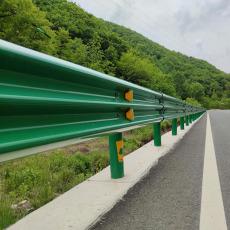
This sign is primarily used in rural mountainous roads, forest roads, and county-level highways with no street lighting. In mountainous areas, it marks the edges of narrow roads, sharp curves, and steep slopes, helping drivers maintain their lane and avoid off-road accidents during night travel. In forest areas, it guides drivers along remote roads, reducing the risk of getting lost or hitting wildlife. Rural road management departments can install it in accident-prone sections to improve road safety and reduce nighttime accident rates. It is also suitable for tourist scenic roads in rural areas, providing safe guidance for visitors driving at night. Additionally, it can be used in remote villages and farm roads to connect isolated communities with main roads, ensuring safe travel for residents and agricultural vehicles.










 Post RFQ


 Chat
Chat


 ALL CATEGORIES