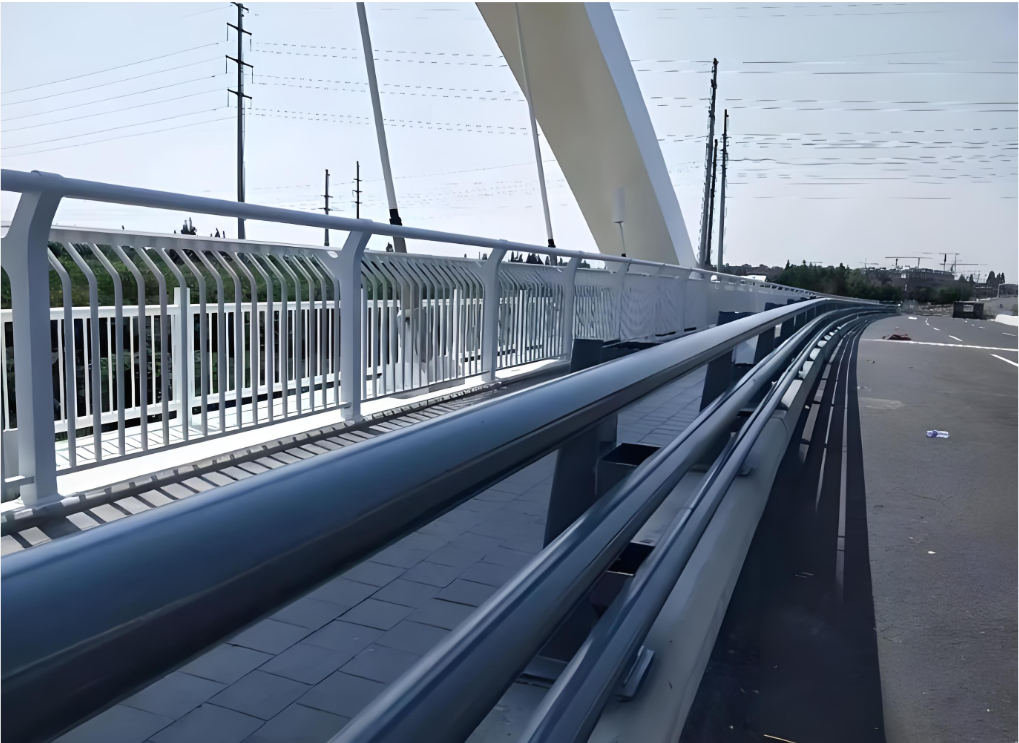
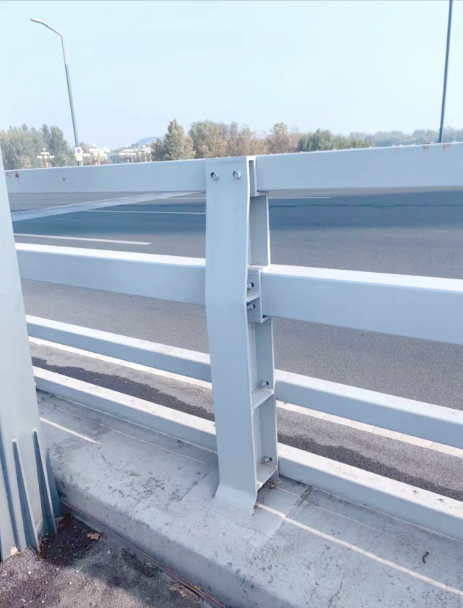





The weathering steel material (Corten A) is a key innovation, as it develops a stable, rust-like patina that prevents further corrosion without the need for painting, reducing long-term maintenance costs by 70% compared to galvanized steel barriers. The transition beam design is engineered to match the height and stiffness of both W-beam metal barriers and rigid concrete barriers, greatly reducing the risk of vehicles vaulting over the transition point. The square tubular posts provide enhanced structural support, while the custom transition terminal is manufactured to fit specific concrete barrier dimensions, ensuring a seamless connection. Additional benefits include compatibility with precast concrete barriers of 900-1000mm height, easy installation on bridge decks using expansion bolts, and compliance with FHWA guidelines for bridge safety. The guardrail’s modular design allows for easy modification to fit different bridge widths and configurations.
Each meter of the guardrail features a transition beam with dimensions of 350mm (width) x 950mm (height) x 3.5mm (thickness), constructed from Corten A weathering steel for corrosion resistance. The square tubular posts measure 150x150mm in cross-section, with a 1000mm length and 4.0mm thickness. Post spacing is set at 1800mm to provide consistent structural support on bridge decks. The guardrail’s transition terminal extends 4 meters from the main barrier, with a design that aligns perfectly with precast concrete barriers. It is rated for maximum impact speeds of 110km/h, with a maximum deflection of 1.1 meters to redirect vehicles safely. Each meter weighs 65kg, and the operating temperature range spans from -45°C to 70°C, suitable for both cold and hot climates. Installation requires four workers per 50 meters in 10 hours, with M20 expansion bolts used for bridge deck anchoring. The patina formation process takes 6-12 months depending on local climate conditions.
This guardrail is specifically designed for bridge-related safety scenarios, including highway-to-bridge transitions where flexible metal guardrails connect to rigid concrete bridge barriers, overpass ramps with mixed barrier types, and elevated road sections with transitions to concrete median barriers. It is also ideal for pedestrian bridge edges adjacent to vehicle traffic, coastal bridges where corrosion is a major concern, and urban overpasses where aesthetic appeal is a priority (the natural patina blends with bridge structures). Additionally, it is commonly used for bridge deck expansions where existing barriers need to be extended, areas near bridge abutments where vehicle impact risk is high, and toll bridge entrances/exits with heavy traffic. The guardrail’s ability to integrate with precast concrete barriers makes it a versatile solution for bridge construction and rehabilitation projects, reducing the need for custom fabrication and project delays.









 Post RFQ


 Chat
Chat


 ALL CATEGORIES