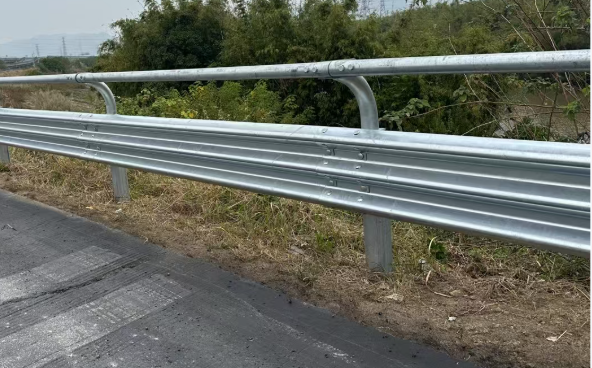
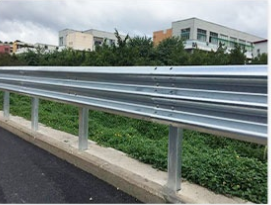





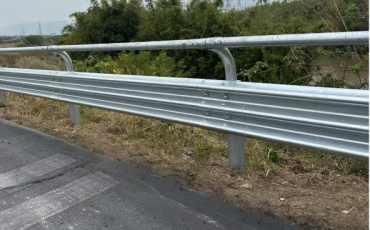
This guardrail incorporates multiple technical highlights to address critical safety pain points. Constructed with Q355 high-strength carbon steel, it boasts a tensile strength of up to 510MPa, 25% higher than standard guardrail steel, and meets AASHTO M180 Level 3 crash resistance standards, capable of withstanding a 10-ton vehicle colliding at 60km/h without failing. The dual anti-corrosion process—hot-dip galvanizing with a coating thickness of ≥85μm plus a polyester powder coating of ≥60μm—ensures no rusting for 30 years, even in coastal or northern regions with heavy de-icing salt use. Its modular bolted design reduces installation and repair time by 40%, allowing quick replacement of damaged components after accidents and minimizing road closure durations. Additionally, the top edge is passivated to eliminate sharp corners, preventing secondary injuries to personnel involved in accidents. The wave-shaped profile’s continuous deformation design absorbs over 60% of impact energy, avoiding vehicle rebound that could trigger chain collisions.
The guardrail’s technical parameters are optimized for heavy-duty performance: W-beam dimensions are 4000mm (length) × 310mm (width) × 812mm (height) with a 4.0mm thickness; columns measure 140mm (diameter) × 4.5mm (wall thickness) × 2150mm (total height), requiring a 600mm burial depth; block-outs are 178mm × 196mm × 200mm × 4.5mm. Connection bolts are M16×45 high-strength galvanized fasteners. The steel has a yield strength of ≥355MPa and tensile strength of 510-610MPa. In crash tests, it limits maximum deformation to ≤1200mm when hit by a 10-ton vehicle at 60km/h, maintaining structural integrity. Salt spray test resistance exceeds 1000 hours without red rust. The standard color is silver gray, with full customization available for RAL color systems. Installation spacing is 2000mm for straight sections, adjustable to 1500mm for curved roads. The total weight per meter, including columns and block-outs, is approximately 68kg.
This guardrail is ideal for high-traffic, heavy-load road segments, including expressway mainlines, interchange ramps, bridge sides, and tunnel entrances/exits. In mountainous expressways, it prevents vehicles from plunging off cliffs; in plain expressway sections, it stops cross-lane intrusions that cause chain accidents. It is also suitable for special road scenarios like airport runway perimeters and port cargo access roads, where high-strength protection is critical. For northern regions with heavy de-icing salt use, the dual anti-corrosion system resists chemical erosion; in coastal areas with salt spray, it maintains its structural integrity and appearance for decades. It is also a key component in highway expansion and safety upgrade projects, providing continuous, reliable protection for all heavy-duty traffic scenarios.











 Post RFQ


 Chat
Chat


 ALL CATEGORIES