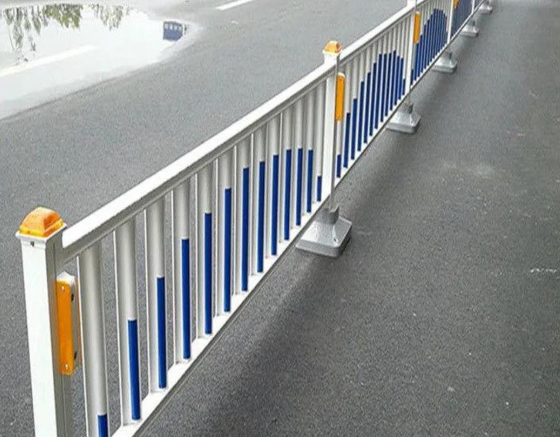
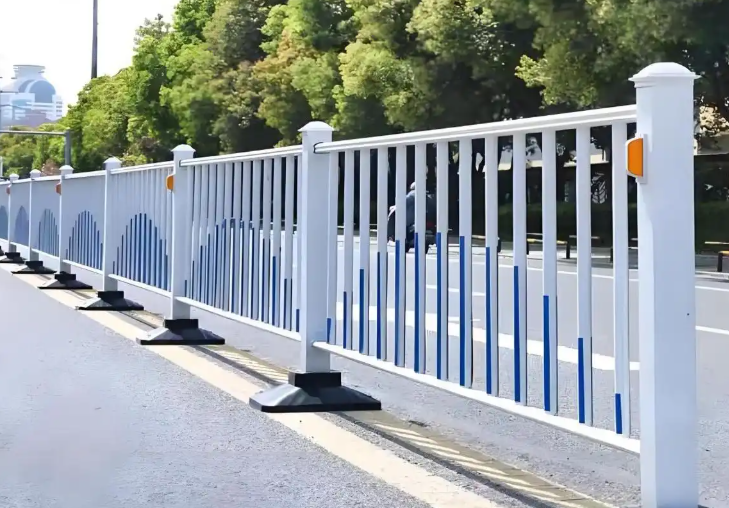





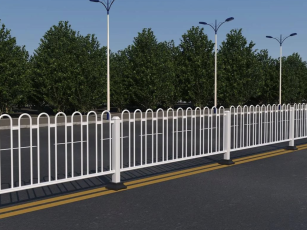
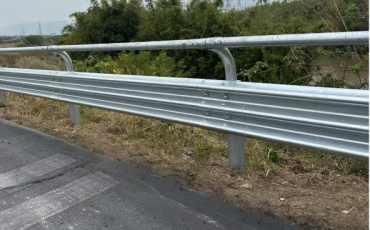
This guardrail’s core advantages address urban road safety challenges. The high-tensile flexible steel alloy has an elongation rate of ≥20%, absorbing over 40% of impact energy through deformation during collisions, reducing pedestrian injury rates by 60% compared to traditional rigid guardrails. It meets EN 1317 Level 2 crash standards, withstanding a 5-ton vehicle colliding at 50km/h to prevent intrusion into sidewalks or non-motorized lanes. The modular design eliminates the need for large construction equipment; a single worker can install one section, cutting construction time by 50%. Its eco-friendly fluorocarbon coating maintains vivid colors for 10 years, enhancing road visibility. Anti-slip ground anchors at the base stabilize the guardrail on wet roads during emergency braking. Damaged components can be replaced individually, with annual maintenance costs only 30% of traditional guardrails, solving the pain points of high urban accident injury rates and low repair efficiency.
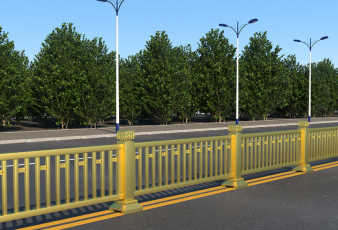
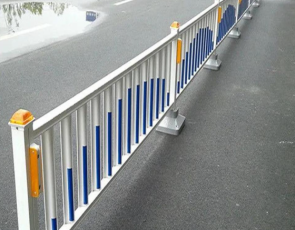
Detailed technical parameters are optimized for urban environments: the main guardrail section is 3000mm (length) × 750mm (height) with a 3.5mm thick flexible beam; columns are 114mm (diameter) × 3.5mm (wall thickness) × 1800mm (total height), requiring a 500mm burial depth. Three sets of spring-loaded energy-absorbing devices are built-in, each providing ≥20kN of buffering force. Connection bolts are M14×40 stainless steel fasteners. The steel alloy has a tensile strength of ≥450MPa and elongation rate of ≥20%. In crash tests, maximum deformation is ≤800mm, with 70% of shape recovery after impact. The anti-corrosion process combines hot-dip galvanizing and fluorocarbon spraying, with salt spray test resistance of ≥800 hours without red rust. The standard color is traffic yellow, with customizable blue, green, or other landscape-friendly shades. Installation spacing is 2500mm for straight sections, adjustable to 2000mm for intersections. The total weight per meter is approximately 42kg.
This guardrail is widely used in urban main roads, secondary roads, intersections, school zones, hospital entrances, commercial pedestrian street peripheries, and urban expressway auxiliary lanes. In school zones, it prevents vehicles from veering into campus premises; at intersections, it blocks turning vehicles from intruding into non-motorized lanes; near commercial pedestrian streets, it protects pedestrians while enhancing street aesthetics. It also serves as a temporary safety barrier for urban construction zones, guiding orderly traffic flow during road repairs. For rainy southern cities, anti-slip ground anchors improve stability; in cold northern cities, the flexible material resists low-temperature brittle fracture. Its ability to balance safety and aesthetics makes it suitable for all urban road scenarios requiring pedestrian protection and traffic order maintenance.









 Post RFQ


 Chat
Chat


 ALL CATEGORIES