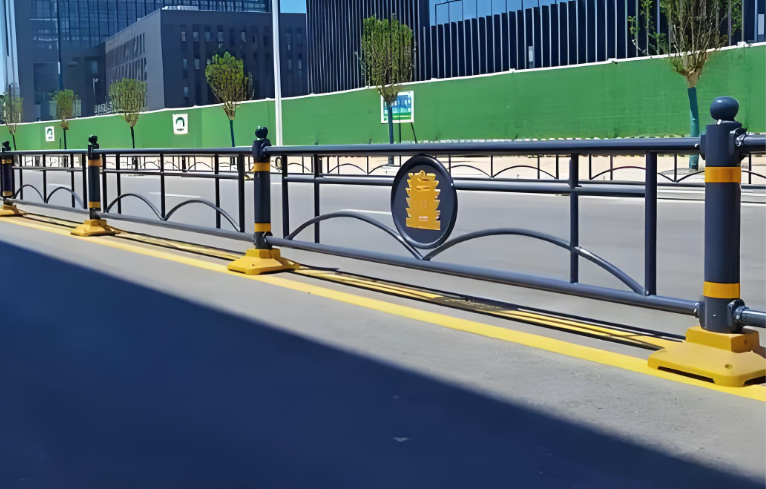
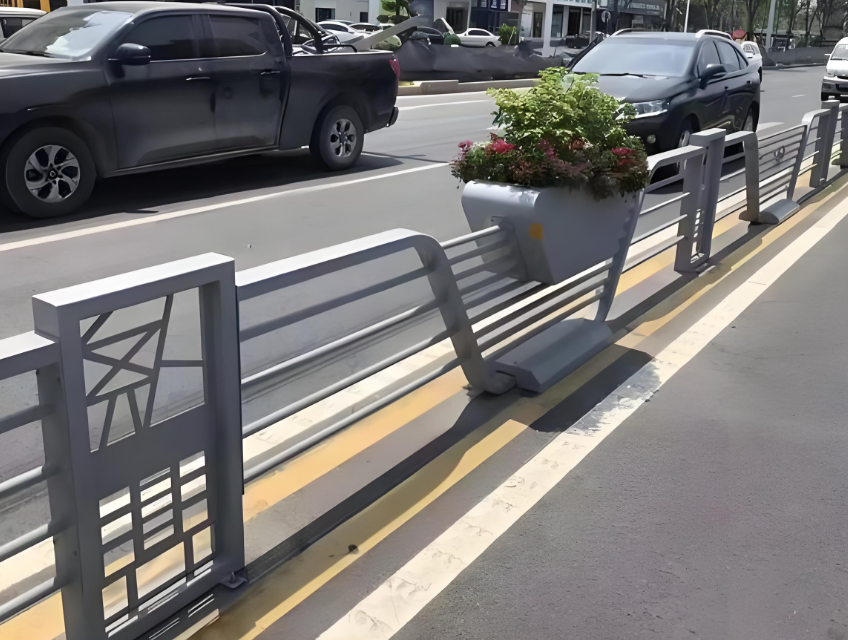





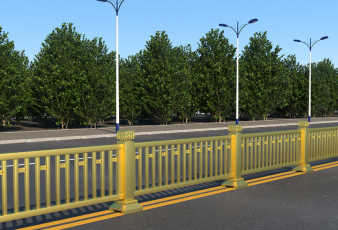
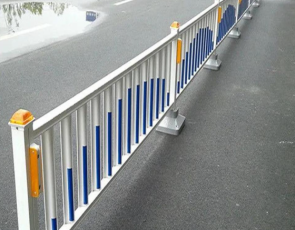
This guardrail combines safety and aesthetics to address traditional guardrail landscape pain points. Constructed from aluminum alloy 6063-T5, it weighs only 40% of steel guardrails, eliminating the need for large installation equipment and improving construction efficiency by 50%. The artistic wave design features laser-engraved or stamped patterns customizable to urban or scenic area cultural characteristics, enhancing road landscape quality. The fluorocarbon coating with a thickness of ≥60μm provides salt spray test resistance of ≥800 hours. The modular bolted design allows individual replacement of damaged components, with annual maintenance costs only 20% of steel guardrails. The top edge is rounded to eliminate sharp corners, preventing injuries to pedestrians and non-motorized vehicle users. It meets EN 1317 Level 1 crash standards, withstanding a 2-ton vehicle colliding at 30km/h to meet basic landscape road safety needs.
Technical parameters balance aesthetics and safety: the main guardrail section is 3000mm (length) × 800mm (height) with a 3.0mm thick aluminum alloy beam; columns are 100mm×100mm (square) × 3.0mm (wall thickness) × 2000mm (total height), requiring a 500mm burial depth. Connection uses M12×35 stainless steel bolts. The aluminum alloy has a yield strength of ≥170MPa and tensile strength of ≥240MPa. In crash tests, maximum deformation is ≤600mm when hit by a 2-ton vehicle at 30km/h. The fluorocarbon coating provides salt spray resistance of ≥800 hours, with no fading for 25 years. Standard colors are bronze and white, with full RAL color system customization available. Optional patterns include willow leaf, traditional Chinese geometric, or scenic area-specific designs. Installation spacing is 2500mm for straight sections. Total weight per set is approximately 18kg, with ROHS compliance ensuring no harmful substance release.
This guardrail is widely used in urban landscape avenues, scenic area core roads, commercial pedestrian street peripheries, park roads, historical and cultural blocks, and campus internal roads. In urban landscape avenues, its artistic design integrates with surrounding buildings and greenery to enhance city image; in scenic areas, custom patterns reflect local culture to improve tourist experiences; near commercial pedestrian streets, vivid colors attract consumers and boost commercial atmosphere; in historical and cultural blocks, retro-style guardrails coordinate with ancient buildings to protect historical style while ensuring safety. It is also used in high-end residential community internal roads to enhance property quality and safety. The rounded design prevents accidental injuries in crowded scenic areas, and the lightweight material minimizes environmental impact in urban core zones.








 Post RFQ


 Chat
Chat


 ALL CATEGORIES