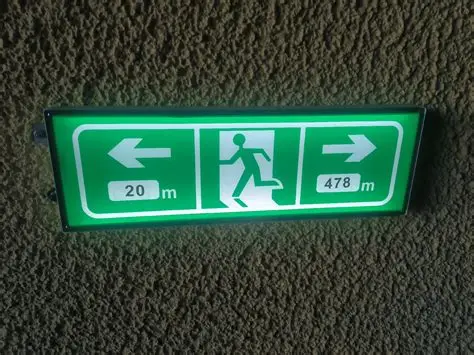
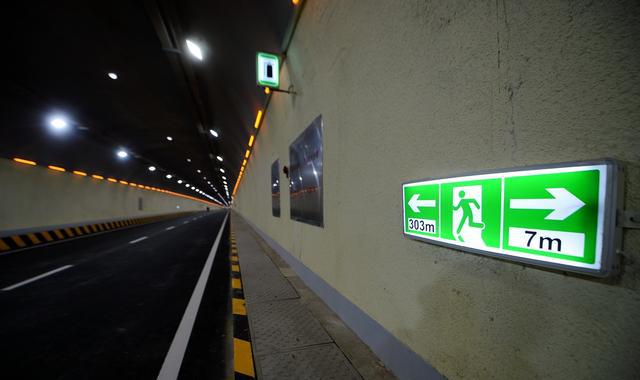





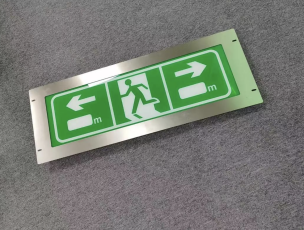

The product’s main advantage is its dual-mode lighting system: in normal conditions, it relies on passive reflection to provide guidance for passing vehicles; in emergency situations such as power outages or fires, the photoluminescent layer actively emits light, maintaining visibility for ≥12 hours after absorbing light for 30 minutes. It has a Class B1 flame-retardant rating, not igniting when exposed to open flames, and emitting low smoke density, solving the pain point of traditional signs becoming ineffective in tunnel fires. The fire-resistant aluminum substrate can withstand high temperatures up to 200℃ without deformation, ensuring structural integrity during fires. Additionally, its smoke-resistant performance complies with GB/T 17651 standards, maintaining clear visibility even in heavy smoke, helping people quickly find escape exits.
The sign has a standard size of 600×400mm, with a 1.2mm thick fire-resistant aluminum substrate and a 0.4mm thick photoluminescent self-luminous film, meeting NFPA 701 flame-retardant standards. The photoluminescent layer has an initial glow brightness of ≥300mcd/㎡ and a 12-hour residual brightness of ≥10mcd/㎡, ensuring visibility at a distance of ≥500 meters in dark environments. The passive reflective layer has a reflectivity of ≥400cd·lx⁻¹·m⁻², meeting GB 2894 safety sign standards. It has a temperature resistance range of -30℃ to 150℃, suitable for tunnel environments with large temperature fluctuations. The wall-mounted model uses stainless steel expansion screws for installation, with a load-bearing capacity of ≥50kg, ensuring stability during earthquakes or fires. All components comply with international tunnel safety certifications, ensuring compliance with local regulatory requirements.
This sign is mainly installed in highway tunnels, urban underground tunnels, and subway tunnel escape passages, marking escape exits, emergency shelters, and fire extinguisher locations. In long highway tunnels, it is installed every 50 meters along the tunnel wall, providing continuous guidance for people escaping from the middle of the tunnel. In urban underground tunnels with high traffic flow, it can be integrated with the tunnel fire alarm system, automatically activating the photoluminescent mode when a fire is detected. It is also suitable for underground parking lots connected to tunnels, guiding drivers to emergency exits during power outages. For new tunnel construction projects, it can be installed in embedded mode to maintain the tunnel’s overall structural integrity, while for existing tunnels, the wall-mounted model allows for quick retrofitting without damaging the tunnel structure.












 Post RFQ


 Chat
Chat


 ALL CATEGORIES