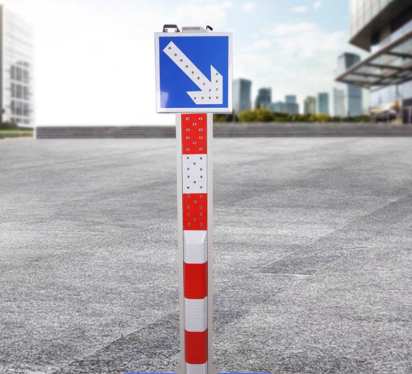
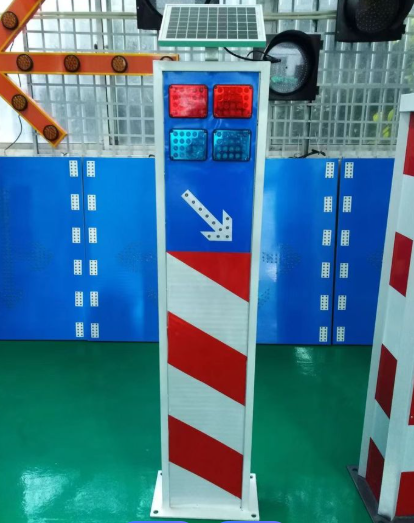








Unlike traditional reflective bollards that rely on external light sources, this bollard features an active light-emitting system with dual modes (stroboscopic and constant light) to adapt to different traffic scenarios: the stroboscopic mode is used in high-risk sections to attract driver attention, while the constant light mode is used in residential areas to avoid disturbing residents. The SMC composite material body is lightweight yet durable, withstanding impacts of up to 5kN without deformation, and its IP68 protection grade ensures it can be fully submerged in water for short periods without malfunction. The 5W monocrystalline solar panel efficiently converts sunlight into electricity, charging a 12Ah lithium battery that supports continuous operation for 15 days without sunlight. The dual installation methods (embedded and adhesive) allow for quick deployment in both permanent and temporary scenarios, and its high-brightness LEDs have a lifespan of ≥50,000 hours, reducing maintenance costs significantly.
The Solar-Powered Active Light-Emitting Warning Bollard has a total height of 1000mm and a diameter of 114mm, with a 400mm embedded section for stable installation. The upper 600mm section is equipped with 12 high-brightness LED beads, each with a luminous brightness of ≥800cd, and a 150mm wide reflective strip around the middle for enhanced visibility. The SMC composite material body has a thickness of 8mm, with a surface hardness of ≥60HRC, providing excellent scratch and corrosion resistance. The 5W monocrystalline solar panel has a conversion efficiency of ≥22%, paired with a 12Ah lithium iron phosphate battery that operates at a voltage of 12V. The stroboscopic mode has a frequency of 2Hz, and the constant light mode consumes only 0.5W of power per hour. It complies with EN 12899-1 standards for road safety equipment, and its weight is 6kg, making it easy to transport and install.
This product is widely applicable to various nighttime road safety scenarios, including urban branch road intersections, rural highway curves, residential community entrances and exits, parking lot peripheries, school and hospital entrances, and temporary construction sections. In rural areas with poor street lighting, it serves as a critical navigation marker to guide drivers and prevent off-road accidents. In urban residential communities, its dual-mode lighting system ensures visibility without disturbing residents' sleep. For construction sections, its adhesive installation method allows for quick deployment to mark the boundaries of temporary traffic zones. It is also suitable for scenic area roads to protect pedestrians and wildlife from vehicle collisions. Traffic management departments, property management companies, and construction contractors can all benefit from its high visibility, low maintenance, and cost-effective design, improving overall road safety in low-light environments.












 Post RFQ


 Chat
Chat


 ALL CATEGORIES