Basic Info
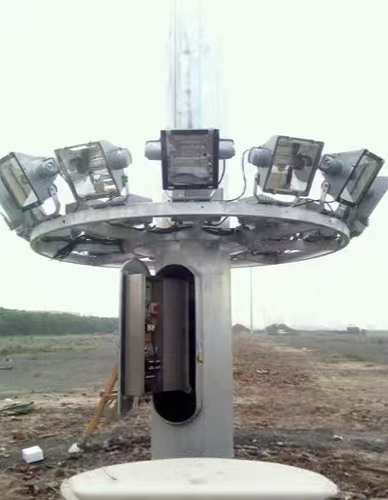
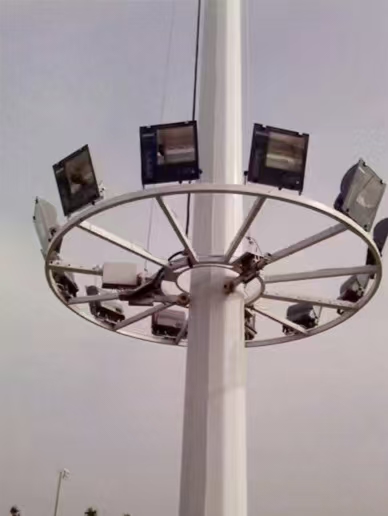
The Hollandia Powerlift is not a complete luminaire but a high-performance electric lowering system integrated within the pole. It represents an innovation in high mast maintenance, transferring all servicing of the luminaire head and electrical components from to ground level. Via an internal wire rope or rack-and-pinion mechanism, the entire head can be lowered safely and smoothly to a man-accessible height, significantly reducing maintenance cost, risk, and complexity.
Product Description
Features
The core is a precision electromechanical hoisting unit with motor,gear reducer,brake,and safety devices(e.g.,fall arrest,overload protection).Lowering is smooth and positioning accurate.Controls are at the pole base,with options for remote operation.The head remains level during travel with anti-rotation features.The system has a mechanical lock,holding position even during a power outage for maintenance.
Specifications
The lowering system has rated load capacity(e.g.,500kg,1000kg)and travel specifications.Lifting speed balances efficiency and stability.The pole design accommodates the internal mechanism while providing sufficient strength and torsional resistance.A manual crank is usually provided for emergency lowering.The system requires regular safety inspections and maintenance.
Applications
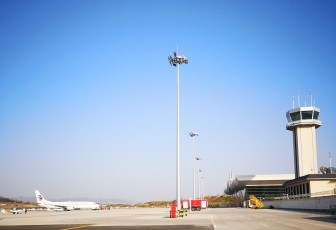
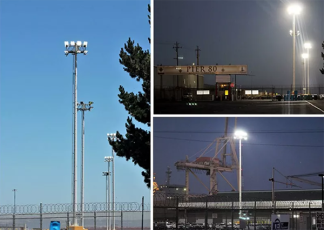
Particularly suitable for locations where maintenance is difficult or costly,such as busy highway interchanges,alongside major airport runways,in active port areas,and central city squares.Any high mast application requiring frequent lamp changes,lens cleaning,or electrical repairs,but where using large cranes is impractical due to road closures,is an ideal candidate.
Frequently Asked Questions (FAQ)
Q:What are the core safety mechanisms of lifting-type high masts?
A:Include wire rope breakage protection,overload protection,upper/lower limit switches,manual lowering for power failure,automatic locking,and real-time status monitoring with fault alarms.
Q:What are common drive systems for lifting,and their characteristics?
A:Mainly electromechanical winch with wire rope,and hydraulic cylinder.Winch is mature tech with easier maintenance.Hydraulic offers smooth operation and high load capacity but requires hydraulic system upkeep.
Q:How to achieve group lifting and lighting linkage for multiple masts?
A:Via a central control platform or local controller using protocols like Zigbee,LoRa,or industrial Ethernet to send unified commands for synchronous lifting,grouped switching,and scene changes with one-touch operation.
Q:How are the lifting and lighting systems electrically integrated yet isolated in design?
A:Typically use power circuits.Lifting motor power and lighting power are separately controlled within the cabinet but share communication/control signals.Ensure separation of power and control wiring to prevent interference.
Q:How does the system provide automatic protection against weather like high winds?
A:Integrates an anemometer.When wind speed exceeds a preset safety threshold,the system auto-alerts and executes a lowering command to bring the luminaire array to a safe height and lock it,preventing toppling.
Q:What are common maintenance points and intervals for smart lifting systems?
A:Regularly inspect wire rope wear,hydraulic fluid level/quality,limit switch sensitivity,and lubricate.Clean lifting slide rails.A comprehensive maintenance check and function test every six months is recommended.












 Post RFQ


 Chat
Chat


 ALL CATEGORIES