
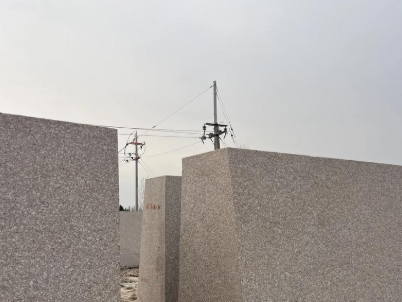


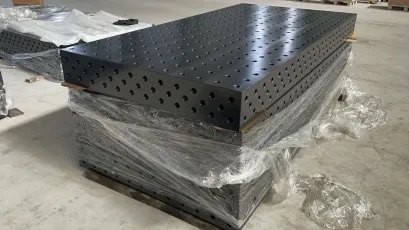
Compared with traditional steel marking platforms, this product has the advantages of no rust, low thermal deformation and high stability. Its 0-grade accuracy meets the industry's heavy-duty processing standards, and the flatness tolerance can meet the positioning requirements of large-scale structural parts. The surface roughness Ra≤0.8μm ensures that the marking line is clear and will not wear the marking tools. The maximum load capacity of 5000kg can support the placement of large-scale workpieces such as ship hull sections and engineering machinery frames. The standard M16 threaded holes can be fixed with fixtures to prevent workpiece movement during marking, and the optional cast iron anti-collision edge can protect the platform edge from damage during heavy use.
The overall dimensions are 1200mm (length) × 1000mm (width) × 200mm (height), and the net weight of a single unit is approximately 2100kg. The flatness tolerance complies with the 0-grade standard of JB/T 7979-2000, with a flatness deviation of no more than 2μm for the 1200×1000mm specification. The Mohs hardness reaches above 60, and the thermal expansion coefficient is 5.2×10^-6/℃. It is equipped with 12 M16 threaded holes as standard, which can be matched with various heavy-duty positioning fixtures. Optional cast iron anti-collision edges can be installed around the platform to reduce the risk of edge damage during handling and use.
It is mainly applicable to shipbuilding yards, engineering machinery manufacturing plants, large-scale hardware processing factories, wind power equipment processing workshops and other scenarios. It can be used for line marking, positioning and scribing of large structural parts such as ship hull sections, engineering machinery frames, wind power tower cylinders and large steel structures. It can also be used as a workbench for large-scale part assembly and debugging, providing a stable reference plane for workers to operate, improving the accuracy and efficiency of workpiece processing and assembly.










 Post RFQ


 Chat
Chat



 ALL CATEGORIES