
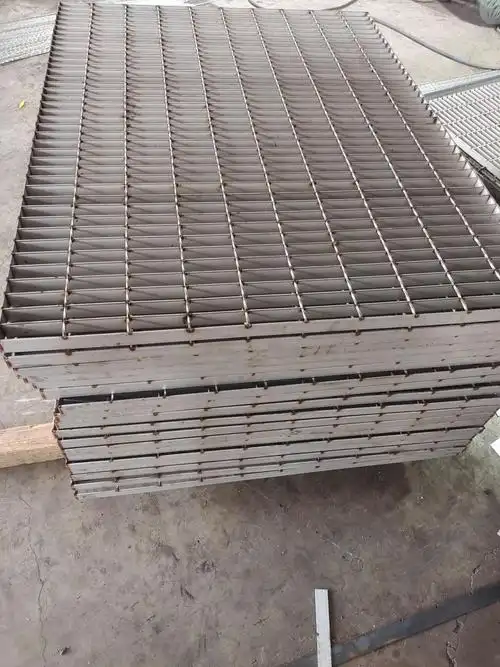


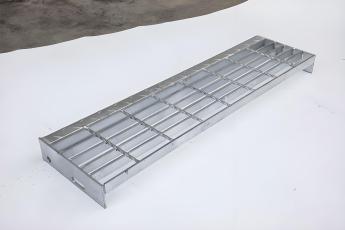
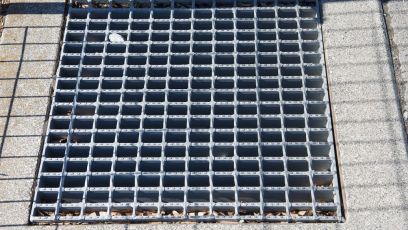
The core advantages of this product lie in its excellent corrosion resistance and hygienic performance. The plug-in locking structure realizes tight connection between flat bars and cross bars without welding, which eliminates the hidden danger of rust at welding joints and maintains the overall corrosion resistance of the material. The passivation treatment forms a dense oxide film on the surface, further improving the corrosion resistance and meeting the FDA food hygiene standards. To solve the problem of easy slipping in wet environments, the surface can be polished into a mirror or matte finish, or serrated flat bars can be selected to improve anti-slip performance. It can be customized according to the needs of different working conditions, adapting to loads ranging from 5kN to 30kN per square meter. The locking installation method does not damage the surface coating, and is convenient for later disassembly and maintenance.
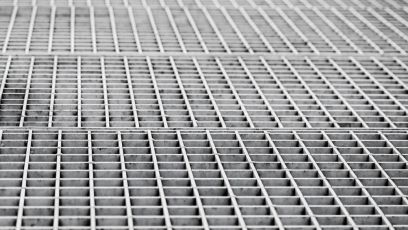
The load-bearing flat bar specifications range from 25×2mm to 50×6mm, and the cross bars are made of stainless steel round steel with diameter from φ5mm to φ10mm. The standard board size is 1200mm×4000mm, and can be cut into any required size. The flat bar thickness ranges from 2mm to 6mm, the load-bearing flat bar spacing can be selected as 30mm or 50mm, and the cross bar spacing can be selected as 50mm or 75mm. The surface passivation treatment thickness is about 1-3μm, and the mirror polishing treatment can reach Ra≤0.8μm. The product self-weight is about 8-18kg/㎡, and the matching locking clips are made of 304 stainless steel to ensure consistent material performance. It complies with ASTM A240 standard for stainless steel materials and ISO 9001 quality management system certification.
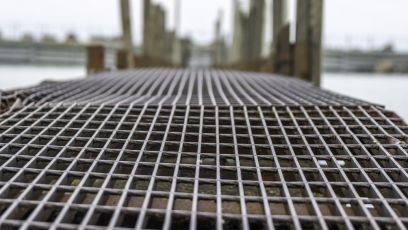
This product is mainly applicable to food processing workshops, dairy production lines, beverage production plants, pharmaceutical clean workshops, coastal building walkways, chemical plant auxiliary passages and other scenarios with high requirements for hygiene and corrosion resistance. It can be used as equipment protective covers, operating platforms, trench covers and stair tread plates in food and pharmaceutical industries, meeting the strict hygiene standards of no pollution and no rust. In coastal areas, it can resist the corrosion of salt fog and humid air, and does not need regular maintenance and painting. It is also suitable for sewage treatment plants with high chloride ion content and other harsh corrosion scenarios.








 Post RFQ


 Chat
Chat


 ALL CATEGORIES