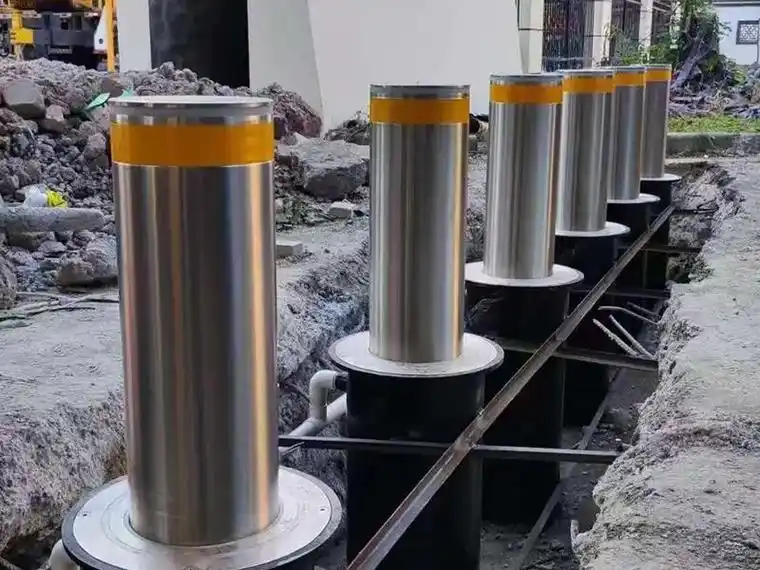



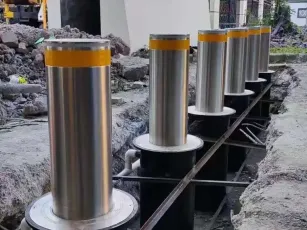
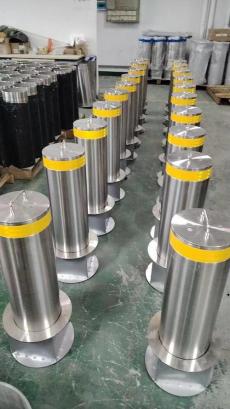
The core advantage of this rising bollard barrier gate is its top-level crash resistance capability, meeting the K12 international anti-terrorism standard, which can effectively resist high-speed vehicle impacts and prevent unauthorized intrusion. The fast lift/lower speed of 2-3 seconds enables quick response to emergency situations, such as quickly closing the passage when a suspicious vehicle is detected, or quickly opening it for emergency vehicles. The backup battery provides 8 hours of standby power, ensuring normal operation even in case of power failure. The vibration alarm system will trigger an alarm immediately when detecting vehicle impact, reminding security personnel to handle it in a timely manner. The 304 stainless steel bollard with reinforced concrete foundation has a long service life, and the IP67 protection grade allows temporary immersion in 1.2 meters of water, suitable for outdoor places with heavy rain or flood risks.
The bollard dimensions are 219mm (diameter) × 1100mm (height above ground), with a buried depth of 800mm. The bollard is made of 10mm thick 304 stainless steel, and the foundation is reinforced concrete with a size of 1000mm (length) × 1000mm (width) × 800mm (depth). The total weight of a single bollard (including foundation) is about 350kg. The lift/lower speed is 2-3 seconds, and the load capacity is up to 150 tons, which can withstand the passage of heavy-duty vehicles. The power supply voltage is AC220V/50Hz, and the backup battery is a 12V 100Ah lead-acid battery, providing 8 hours of standby power. The protection grade is IP67, which can withstand temporary immersion in 1.2 meters of water for 30 minutes. The operating temperature range is -40℃ to 75℃, and the humidity range is 5%-95% (no condensation). The crash resistance grade is K12, which can stop a 7.5-ton vehicle traveling at 80km/h without deformation.
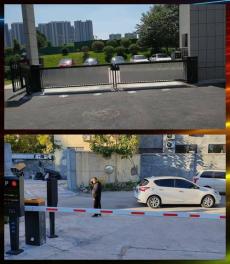
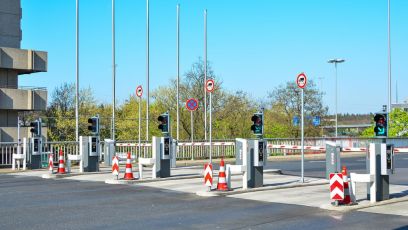
This anti-terrorism rising bollard barrier gate is widely used in high-security places such as government agency entrances, bank headquarters, embassies, high-speed rail stations, airports, and nuclear power plants. In government agency entrances, it can prevent unauthorized vehicle intrusion and terrorist attacks, protecting the safety of government personnel and facilities. In bank headquarters, it can stop robbery vehicles and ensure the safety of cash transport and bank employees. In embassies and consulates, it can prevent vehicle attacks and protect foreign diplomatic personnel. In high-speed rail stations and airports, it can manage the passage of vehicles in restricted areas, ensuring the safety of passengers and airport facilities. In nuclear power plants and other key infrastructure sites, it can prevent malicious vehicle intrusion and protect national key facilities. It is an essential security equipment for all types of high-security places that require strict vehicle access control.








 Post RFQ


 Chat
Chat


 ALL CATEGORIES